On the second day of our week learning about the work of Mano a Mano we drove in our trusty bus just to the outskirts to Cochabamba to the Center for Ecological Agriculture (CEA). My green suitcase, holding the grinder, also made the trip. But it had collected all the seeds that everyone had brought along as well a six oil filters for airplanes, also brought along in suitcases by trip colleagues.
(I did find two notes from TSA that someone had inspected my suitcase with the grinder. That surely didn't surprise me! And in Santa Cruz, the suitcase inspectors became alarmed about the oil filters. When assured that the filters were new and didn't contain any petroleum products, everything was fine.)
This is the newest effort of Mano a Mano. If I had to sum up the work of CEA in a few words I would say it's about saving every drop of water and every bit of nutrients that the soil has for reuse.
I was truly amazed at what has been accomplished in just one year, particularly when you realize it started with this:
What is shown above? The soil! Having been raised the black gold soil of Iowa this type of soil really amazed me! The soil here is full of clay which sheds water rather than retains water.
And as a reminder about how dry this area is, here's what I found growing along the fence.
Now one year later the CEA has a large building, used for classes and other activities.
I took this picture primarily as a reminder that the roof is constructed to rain water and then have it go down a drain spout for collection and eventual flow in a holding pond elsewhere on the property.
As a reminder, too, this is a climate in which rain falls primarily during the three months of summer and then no rain or other precipitation for the next nine months, so it is critical to save, store, and reuse every drop of water.
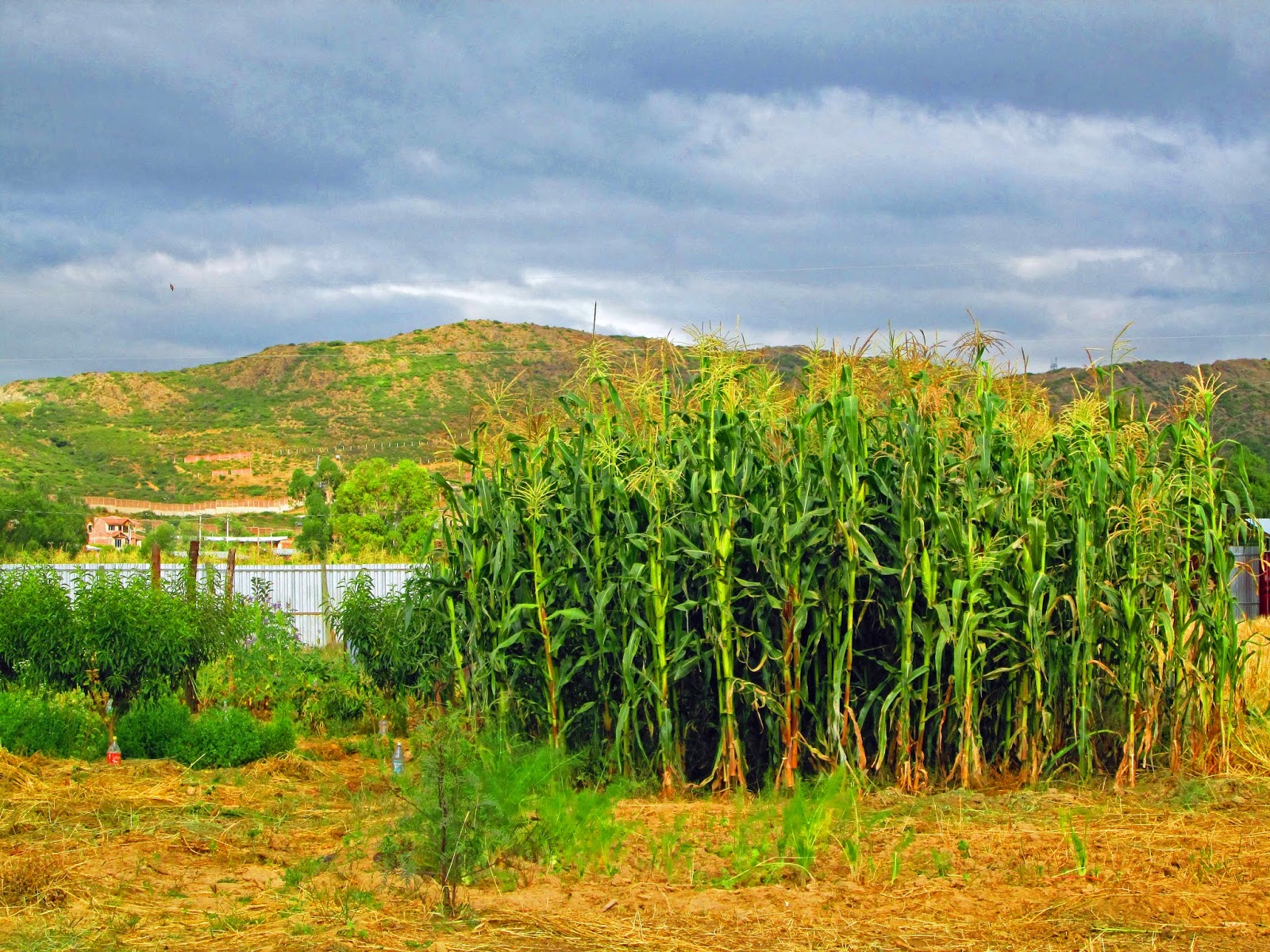
Corn (maize) is an important product for food in Bolivia so of course it is part of the demonstration crops.
A crop new of me is fava beans.
Sunflowers are for the oil.
I shared that the green center from the sunflower is often found in the produce markets in Poland during the summer. Now my job is find an example of this during my summer stay in Poland. And speaking of Central Europe foods, beets were an unexpected find in Bolivia.
The CEA is also starting a fruit orchard.
The trees are only one year old, so quite small yet. Interspersed with the rows of trees are rows of legume plants. These grab nitrogen out of air and bring nutrients into the soil. Secondly, the roots of these plants help to aerate the soil and make it retain water better.
In the photo above we are learning about placing compost around each tree to conserve soil moisture -- yes, perhaps not a new idea where some of the blog readers live, but a practice not found in Bolivia. Soda bottles have some holes punched in them to provide drip irrigation. And a wisp of sheep wool is placed around the tree stem to prevent ants from crawling up the tree trunk and eating all the tree leaves.
Two interesting features at CEA about reuse are the compost toilet and the biodigester.
The compost toilet is here for two reasons. The first is to demonstrate that it doesn't stink! Secondly, it is here to demonstrate how to make it work. This particular type has two toilets -- one for liquid human waste and one of solid human waste.
The liquid human waste flows into a system that also includes the gray water from dish washing and laundry. It moves through a sedimentation tank where fats for example from food waste and soaps rise to the top. The cleaner liquid then flows into another tank where it additionally cleaned.
The biodigester is for animal waste. The CEA has chickens, guinea pigs -- not as pets, remember this is a food source in South America, sheep, and cow. I feel like I forgetting something, but the point again is not raising animals, but rather having just enough for demonstration.
The demonstration also is that animal pens can be kept clean and the waste used. Up in a village I saw sheep standing in manure. When I see something such as this that doesn't make sense to me, I try to remember that in another culture it must make sense, and that I simply don't understand what was the original or perhaps even the current reason. However, it is not healthy for animals to live like this and the point of the CEA is to demonstrate other ways of doing things, and ways of doing things are economically feasible within the context of rural Bolivian agriculture.
And perhaps here is perhaps a good place to mention a mission of Mano a Mano -- developing the capacity of Bolivians to help Bolivians. The agronomists who work at CEA are Bolivian, not Americans telling Bolivians what to do.
Now back to biodigester:
The biodigester is the area covered with the black net. One of byproducts of this process is methane. The methane can be harvested and used in a burner for cooking or in lamps for light. If this sounds wild, please remember that in many mountain villages there is not electricity. Secondly, if the methane can be used as a cooking fuel than other organic matter can be left in the soil to add nutrients back to it.
In the CEA building there were three busy with the process of making peanut butter.
They are manipulating the peanuts over mesh wire to remove the brown film found on each peanut. They are also inspecting the peanuts to remove any that look damaged or suspect for some reason.
During the lunch time some of us were privileged to meet these workers. It turns out they are food science students from San Simon University. One of them is doing her thesis on peanut butter, so being involved in this initial production of peanut butter was heaven made for her. She explained that people in different countries have different tastes in peanut butter. She reasoned that people in Bolivia like sweet things -- a surprise to me since over the whole week I never had anything that was really sweet-- and so she formulated a peanut butter that contains just a bit of honey. Indeed it is very good!
This discussion led we Americans to talking about taking peanut butter sandwiches in our lunch bags to school. Another of the students said, "That sounds gross. This is lunch."
Rice, fava beans, beets, and chicken. This lunch has a bit of yellow cast because we were eating under a yellow picnic shelter.
During the afternoon we walked next door to Nuevo Mundo (New World).Nuevo Mundo is the Mano a Mano organization that constructs roads and reservoirs. Presently a building is being constructed for the repair and maintenance of the heavy equipment associated with this work.
One of the cost saving measures used by Mano a Mano is cross training of workers. Here the man welding structures one day might be doing some transmission work on a road graders another day.
We returned to our hotel for short rest and then went for a visit to the Democracy Center located in Cochabamba. Getting taxis during rush hour was indeed a cultural experience!
We finished the day by walking about 10 minutes to restaurant called Tuesdays. I had a barbequed chicken sandwich, which seemed as improbable as the night I had a pulled pork sandwich in Pecs, Hungary! But both were good!
Now I have written two posts about the work of Mano a Mano. This organization is totally supported by donations and other fundraising efforts. If you find yourself willing to donate, please click here. Even what one would spend weekly on coffee breaks can be used for very good purposes.Such donations would be tax deductible for U.S. residents.
And I do put my volunteer hours and money where "my mouth" is too.
Observations about the wonderful, unexpected, and sometimes mundane things that should be noticed and celebrated whether found two steps out the door or thousands of miles away.
Thursday, March 27, 2014
Out into the Bolivian Countryside
Our first full day in Bolivia of course began with breakfast. I was delighted to find I could have what I call Polish breakfast -- a good bread roll with cold cuts and cheese. Also the breakfast buffet at the hotel had a nice selection of fruit everyday with pineapple and watermelon being my favorites. And the coffee was so very, very good -- black thick coffee that needed a bit of leche (milk) with it.
Then we boarded the bus with the idea that we were going to a potato farm.
Above is what the rural area looks like on the route we took.
And I got my first view of what farm fields look like in Bolivia.
The brighter green areas are crops. Crops are planted in an area of the mountainside that has water and nutrients. Also because this area is very dry, a good farmer will leave some land fallow for 1-3 years or more so that moisture may accumulate there and support a crop.
After some driving we started to see a body of water and suddenly I realized I was seeing the Ucuchi Reservoir that I had heard so much about.
A reservoir is really part of indigenous agriculture but over time many of the reservoirs deteriorated and farmers simply don't have the monetary resources to repair or reconstruct them. This particular area had a reservoir but the lining was not effective. Water would simply percolate through the bottom of the reservoir area and disappear.
Perhaps before further, I should explain that in the part of Bolivia rains comes for about the 3 months of the summer and then there is no rain for the next nine months. One has to store water.
The Ucuchi Reservoir was completed by the community in this area with the help of Mano a Mano in 2005. It serves about 600 families. The access to water helps the farmers to raise a more productive crop and sometimes also to raise a second crop. And like perhaps people everywhere, Bolivians are attracted to water. The reservoir is stocked with fish. The reservoir is also providing economic development. Dirt bikes races are now held on the road around the reservoir. Someone is building cabins for visitors. Just the increase of agricultural crops alone has allowed the farmers in this area to double their income. Now before anyone gets the wrong idea -- these are not rich people! The increase for a family farmer increased from about $150/year to $300/year. Yes, costs are less in Bolivia than in the United States or the EU, but $300/year still does not make one "rich."
And the area about the reservoir also has a playground for children. Some of my trip colleagues tried out one of the swings.
A short time after leaving this site, we came upon an area where road construction was underway.
Yes, not a very good picture but the best I could do out the bus window. Note how hand labor intensive is this work.
After driving through the construction area we came upon the barrier preventing traffic from driving onto the road from the other direction.
It didn't take too long for the men on the bus to remove and then replace this barrier!
We continued our journey through the mountainous countryside, stopping at a school to leave donated books, notebooks, and writing supplies.
These types of supplies as well as all the donated medical supplies originate basically in the Twin Cities area. If somehow people in other parts of the country could figure out how to donate the things that would normally be thrown away, we could really change the world!
I learned at one of the school stops that supplies are so tight that Bolivian school children write in a notebook with pencil, and then when the course is completed, erase the entire notebook so that it can be used over again.
In just a few minutes we arrived at the "potato farm." Actually the first thing we all visited was the toilet.
I quickly learned that the household is made up of a number of buildings. The toilet and sink appears above attached to a room that held a table and chairs and two beds. To the left of these structures was another building that held a kitchen stove, supplies such as potatoes and spices, and a small table for food preparation. Beside it was another small building for additional cooking.
This type of cooking pot is standard -- at least for all the cooking that I observed. It is about 18 inches tall.
I was the last person in the line for the toilet and by then most others were down the hill talking. I asked if we were to be there and someone told me no. So I went back to the bus because I thought we were going to on to another reservoir in a few minutes. There I found three curious girls.
In this part of Bolivia most speak Quechua, not Spanish. My elementary Spanish was of no use at all. I went to find someone to help and found ladies shucking corn. Well, I know how to do that, so I helped.
About the time this task was completed we did take a short trip up the road to see another reservoir.
After this visit we returned to the farm for a mid-day meal.
Yes, an ear of corn, two potatoes and piece of cheese. The corn is quite delicious. Even though it had been picked at a somewhat earlier time it had retained its "sweet" flavor. The individual kernels are also much larger than sweet corn kernels typical in the United States.
After the meal we were witnesses to a long discussion about completion of the second reservoir. This one is apparently entangled in a dispute about whose water it is and where it should go with the governor of the department (department is like state or province in other countries) having a different idea than the municipality leaders. The farmer directly looked at us and asked what we Americans could do about this. One of my colleagues was quick minded and replied that we would send our help through Mano a Mano.
We eventually made our way back to Cochabamba where we took a short rest and then held a meeting to process our ideas about what we had seen during the day. Then we walked almost exactly across the street from the hotel to a Middle Eastern restaurant and had a lovely evening meal. A very busy day again in Bolivia.
Then we boarded the bus with the idea that we were going to a potato farm.
Above is what the rural area looks like on the route we took.
And I got my first view of what farm fields look like in Bolivia.
The brighter green areas are crops. Crops are planted in an area of the mountainside that has water and nutrients. Also because this area is very dry, a good farmer will leave some land fallow for 1-3 years or more so that moisture may accumulate there and support a crop.
After some driving we started to see a body of water and suddenly I realized I was seeing the Ucuchi Reservoir that I had heard so much about.
A reservoir is really part of indigenous agriculture but over time many of the reservoirs deteriorated and farmers simply don't have the monetary resources to repair or reconstruct them. This particular area had a reservoir but the lining was not effective. Water would simply percolate through the bottom of the reservoir area and disappear.
Perhaps before further, I should explain that in the part of Bolivia rains comes for about the 3 months of the summer and then there is no rain for the next nine months. One has to store water.
The Ucuchi Reservoir was completed by the community in this area with the help of Mano a Mano in 2005. It serves about 600 families. The access to water helps the farmers to raise a more productive crop and sometimes also to raise a second crop. And like perhaps people everywhere, Bolivians are attracted to water. The reservoir is stocked with fish. The reservoir is also providing economic development. Dirt bikes races are now held on the road around the reservoir. Someone is building cabins for visitors. Just the increase of agricultural crops alone has allowed the farmers in this area to double their income. Now before anyone gets the wrong idea -- these are not rich people! The increase for a family farmer increased from about $150/year to $300/year. Yes, costs are less in Bolivia than in the United States or the EU, but $300/year still does not make one "rich."
And the area about the reservoir also has a playground for children. Some of my trip colleagues tried out one of the swings.
Yes, not a very good picture but the best I could do out the bus window. Note how hand labor intensive is this work.
After driving through the construction area we came upon the barrier preventing traffic from driving onto the road from the other direction.
It didn't take too long for the men on the bus to remove and then replace this barrier!
We continued our journey through the mountainous countryside, stopping at a school to leave donated books, notebooks, and writing supplies.
These types of supplies as well as all the donated medical supplies originate basically in the Twin Cities area. If somehow people in other parts of the country could figure out how to donate the things that would normally be thrown away, we could really change the world!
I learned at one of the school stops that supplies are so tight that Bolivian school children write in a notebook with pencil, and then when the course is completed, erase the entire notebook so that it can be used over again.
In just a few minutes we arrived at the "potato farm." Actually the first thing we all visited was the toilet.
I quickly learned that the household is made up of a number of buildings. The toilet and sink appears above attached to a room that held a table and chairs and two beds. To the left of these structures was another building that held a kitchen stove, supplies such as potatoes and spices, and a small table for food preparation. Beside it was another small building for additional cooking.
This type of cooking pot is standard -- at least for all the cooking that I observed. It is about 18 inches tall.
I was the last person in the line for the toilet and by then most others were down the hill talking. I asked if we were to be there and someone told me no. So I went back to the bus because I thought we were going to on to another reservoir in a few minutes. There I found three curious girls.
In this part of Bolivia most speak Quechua, not Spanish. My elementary Spanish was of no use at all. I went to find someone to help and found ladies shucking corn. Well, I know how to do that, so I helped.
About the time this task was completed we did take a short trip up the road to see another reservoir.
After this visit we returned to the farm for a mid-day meal.
Yes, an ear of corn, two potatoes and piece of cheese. The corn is quite delicious. Even though it had been picked at a somewhat earlier time it had retained its "sweet" flavor. The individual kernels are also much larger than sweet corn kernels typical in the United States.
After the meal we were witnesses to a long discussion about completion of the second reservoir. This one is apparently entangled in a dispute about whose water it is and where it should go with the governor of the department (department is like state or province in other countries) having a different idea than the municipality leaders. The farmer directly looked at us and asked what we Americans could do about this. One of my colleagues was quick minded and replied that we would send our help through Mano a Mano.
We eventually made our way back to Cochabamba where we took a short rest and then held a meeting to process our ideas about what we had seen during the day. Then we walked almost exactly across the street from the hotel to a Middle Eastern restaurant and had a lovely evening meal. A very busy day again in Bolivia.
Wednesday, March 26, 2014
Sunday Afternoon in Cochabamba
After some rest and unpacking, we -- a group of 12 gathered by Unity Unitarian Church in Saint Paul-- walked with our trip leader a short distance to a street cafe for a snack. While it may sound boring -- it was a great pleasure to be outdoors in pleasant weather, seeing palm trees, after the horrid winter we had experienced in Saint Paul.
The purpose of this trip was to see activities of Mano a Mano, an NGO based in Saint Paul that works out of Cochabamba. Click on: Mano a Mano for much more information. This organization's first work was to bring health services to indigenous Bolivians up in the Andes Mountains who lacked such services unless walking for 6-12 hours. Mano a Mano has now built 148 health clinics in Bolivia. The next work was to build some schools and teacher housing. Housing is so scarce in mountain villages that it was impossible for a young teacher to come out into the mountains and teach in a village school. Mano a Mano has also built nearly 1000 K of roads in places that lacked connection with the outside world.
Our specific purpose was to learn more about the new Center for Ecological Agriculture (CEA and nicknamed with Spanish pronunciation as "Say-a."
The founders of Mano a Mano are Joan and Segundo who live just down the street from me here in Saint Paul.
That said, back to eating.
A popular snack food in this part of Bolivia is an empanda. This one, with a bite out of it before I thought to take the photo, is filled with cheese. The cheese I would call a cousin of the white farmer's cheese that one finds in Central Europe. It has a hint of a salty taste, and has a bit more firm texture than the white cheese in Central Europe. I liked it very much since I enjoy always the cheese in Central Europe. The bun itself is made with wheat flour, but I can't determine what the leavening is. I learned one rolls out the dough, cuts the circle, places filling on one, and then covers it with a second circle and pinches it shut. It is then baked in an oven. Here I also had some pineapple sorbet. Oh my! it is good.
We then walked back to the hotel and boarded the bus to go up to the Christos monument. Yes, this is a touristy thing to do, but there were lots of Bolivanos up there too on a Sunday afternoon.
As we made our way up the mountain I got these views of the country side:
These are part of the Andes chain that goes along the west side of South America. You may think these mountains don't look very high. Cochabamba is already at 8000 feet (2438 meters). The city appears to sit in a bowl with the mountains surrounding it on all four sides.
From the parking lot we got a good view of the city as well.
There are about a 100 stairs from the parking lot to the base of the monument. I went up the stairs slowly since I don't walk stairs much at all anywhere, based on a orthopedist's advice nearly 15 years ago not to use my damaged knees for walking stairs or riding bicycles. And walking stairs at 8000 feet is a bit of challenge too. But eventually, by going slow, I got there.
One thing that surprised me on this day is just how dry is Cochabamba. Here are cactus used in the landscaping around the monument. I knew Cochabamba has been regarded as the breadbasket of Bolivia so wasn't expecting the climate to be quite so dry.
Now I've been saying monument. Here's a view from the bottom of the stairs:
And the above view is from the plaza around the base of the monument. Over and over again web sites say this is the tallest statue of Christ anywhere in the world. It's official name is Christo de al Concordia -- the Christ of Peace. It was constructed in the late 20th century. The statue is 34.20 meters (112.2 ft) tall, on a pedestal of 6.24 meters (20.5 ft), for a total height of 40.44 meters (132.7 ft). Much to my amazement Wikipedia says this statue is taller than one in Poland if one excludes the crown worn by a similar statue in Poland. In all the times I've been in Poland no one has ever mentioned to me there is such a similar statue in that country.We enjoyed walking about up in this area and had a group picture taken -- that may catch up with me someday.
After about an hour's visit we gathered again at the bus and then made our way through the city.
Street markets and little shops were one could get food or beverage were busy on this late Sunday afternoon.
Then suddenly I was attracted to this intersection with some outstanding murals.
I didn't see anything similar anywhere else in the city. When I asked later about why the murals were here I was told, "it's a pretty intersection." Well, yes, but I'm still wondering why here.
Others were getting off the bus while I was mural gazing. We had arrived at a building I had heard about. Segundo and his brothers who live in the United States had constructed a building to house their parents in Cochabama. Then they proposed extending the building so one of the Bolivia siblings could live close to their parents as they aged. The father said he couldn't chose between his children, so the building got bigger so all the siblings in Bolivia could live in the same building.
We went up to the sixth floor which serves a common area.
Above is a view from the veranda area on the sixth floor.
Three were busy cooking in the barbeque area.
A nearby table was covered with food.
We started with vegetables.
I was surprised to see beets often in Bolivia. I had never before associated that vegetable with South American cooking.
From the barbeque came dishes meats -- sausages, chicken, and pork -- as well as grilled eggplant.
Oh! It was all good.
After good conversation, the bus returned us to the hotel were I think we all crashed after a busy Sunday that had followed a "red-eye" flight out of Miami.
From Saint Paul to Cochabamba
On Friday, March 14 I left Saint Paul for Cochabamba, Bolivia. But first there was "a bump in the road." The previous evening my tax preparer had called and told me I owed a lot of taxes yet above what has already been withheld. That news was somewhat upsetting, and I didn't sleep very well. I also was a bit nervous about being up in time to meet the 7:30 am shuttle to the airport and so decided to just give up sleeping about 4 AM and get ready to leave.
I was downstairs at the 10th Street entrance of the building about 7:10. I sat on a sofa in the lobby with my phone in my hand for the previous time when I had taken the shuttle the driver got a bit lost because my building has a new address in many systems. I realized I had my apartment keys in a jacket pocket and that didn't seem very safe. I put them away in my tote bag safely, looked up and saw the shuttle outside the door, about 10 minutes early.
Off we went to the airport which I quickly discovered was in chaos because many schools in the Twin Cities area had started spring break and many people were traveling. I was told to go to another place to check my luggage and ended up waiting in a line of about 50 people just to do that. Since I was traveling a day ahead of most of the group going to Bolivia I thought I would send an e-mail to the trip leader suggesting others leave plenty of extra time when they arrived at the airport -- and now where was the phone? I backtracked my route through the airport, went back and was able to search the shuttle, checked the counter where I checked in the luggage -- and no phone. I couldn't imagine what I had done with it.
I managed to find a pay phone and left a message for my daughter asking her to suspend service on the phone. I had my kindle with me and was able to go online with that at the MSP airport -- which has full Wi-Fi service and found the customer care number for T-Mobile just before boarding the plane to Miami.
At Miami without a phone I couldn't call the hotel shuttle so had to take a taxi. After seeing my desired address the taxi dispatcher told me I had to wait for a "blue taxi." When one appeared colored blue rather than yellow, he directed me there. The driver of this taxi complained the whole way about taking me to the address. Why was I in a blue taxi? I had no idea. I was just doing what the dispatcher had directed me to do.
At the hotel things got better. I was greeted with the news that I now had diamond status with the Hilton Honors program and was given a bag with cookies and two bottles of water. I was told also to select two items from the nearby pantry area.
Upstairs in my room I called T-mobile and put my phone is suspension. The last thing the customer service officer said to me was "Mame, don't worry, you have insurance on this phone; it will be all right." I also called my daughter again even though I knew the charge from a hotel room would be rather high. Her first words were "Oh, mom, I am so worried about you. I can't suspend your phone." I told her I had taken care of that.
I went down to sit by the pool for awhile.
It was actually a bit too cool to do that, so I went inside to the lobby and sat down to read to a bit and let my blood pressure come back down to normal! I enjoyed an early supper in the hotel restaurant and then went walking a bit around the hotel.
I like this bench.
Here's what the sky looked like -- this explains why sitting by the pool was a bit too cool.
I went to bed early to make up for the previous somewhat sleepless night.
The next morning I enjoyed a complementary breakfast. I left for the airport about 11:30 AM for I had made plans to meet some of the other trip participants. Since I was without my phone they couldn't call me so I thought I would search likely places. I was glad to be relieved of the suitcase holding the peanut grinder.
I saw the sculptures in the North Terminal of the airport many times as I walked up and down looking for others. We had established two meeting places, the gate for our flight departure to Bolivia and the La Careta Restaurant. I went to the restaurant and had a sandwich for I was interested in some lunch. I was glad to have my Kindle for reading and also found a place to charge it, so hopefully it would also be available during the flight.
Finally about 6:30 PM I found some of the others going on this trip and enjoyed a bit of rice pudding at the La Careta. And then finally our flight began to appear on the departure displays.
We were indeed off to Bolivia at 11 PM. I was able to sleep a bit on the flight. We landed at La Paz about 5:30 AM.
We were to continue to Santa Cruz staying on the same plane. I was surprised to find we had to get out of seats while airplane staff totally took every seat apart to ascertain we were not smuggling in drugs -- well, not just us -- every seat was searched.
After about an hour we were on our way to Santa Cruz. We were handed a sheaf of paperwork. These were not to easy to fill out when half asleep!
On the way to Santa Cruz I got a great view of the Illimani Mountain. This is one of the higher mountains in the Andes. It is 21,122 feet (6438 meters). Illimani is an Aymara word, not Spanish, but I don't know the meaning of the word.
The flight between La Paz and Santa Cruz is only about one hour. When we landed there I noticed a Coca Cola ad on every window frame as we walked along the hallway to immigration. Going down the final set of stairs I found a full wall ad.
Here most of us got stopped and shunted to another line because we didn't have a visa to enter Bolivia. The Bolivian consul in the United States had told the trip leaders that we would have a special fee of $85 rather than $135 because we were not coming exactly as tourists. However no one had told the Bolivian immigration officers the same piece of news. After a long discussion we each paid the $135, but not before filling out another piece of paper. The immigration officer than transferred this information along with a photo onto a very formal certificate file, about 10 x 12 inches. I thought that was going to be quite something to carry about, but then discovered that the Bolivian government keeps that form, and instead in my passport, I have just a piece of paper.
This visa is good for five years in case I wish to go back.
We then gathered our luggage and waited in a very long line to walk through the door that said, "Nothing to declare." I would estimate there were about 40 people ahead of me.
Our next goal was then rechecking baggage for a BOA flight to Cochabamba. This went quickly and we gathered in the gate to wait for our flight. There is saw something I've never seen before.
This is a freezer holding fresh meat, that one can buy and take on the plane -- but I truly have no idea why, nor did I see anyone buy any meat.
Our flight to Cochabamba was about 45 minutes. Soon we had gathered our luggage and were boarding a bus to the hotel.
The weather was a pleasant 75 degrees (23C) or so. Since we have had a terrible winter in Minnesota, this was more than a pleasant change!
Quickly we arrived at the hotel.
The staff at the hotel are so very gracious. There is always bottled water available in one of those type of coolers from which one can select cold water to refill one's personal water bottle or hot water to make tea or coffee. The porters were quick to help with luggage. I couldn't figure out why one of them spoke English so very well, but over the course of the week I learned that as a child he had been adopted by an American medical missionary and was raised in the United States. He is now back in Bolivia going to a university there and working as porter at the hotel. He was quite intrigued to discover that my large suitcase held a peanut grinder!
We settled down for a bit of rest. I had a lovely room. The electrical outlets in Bolivia are the same as for Europe so I had all the right stuff. I actually spent most of this rest time in the nearby courtyard, because I knew if I tried the bed I would sleep for probably six hours and miss the activities for the remainder of the day.
But that's a whole another story which will appear in the next post.
I was downstairs at the 10th Street entrance of the building about 7:10. I sat on a sofa in the lobby with my phone in my hand for the previous time when I had taken the shuttle the driver got a bit lost because my building has a new address in many systems. I realized I had my apartment keys in a jacket pocket and that didn't seem very safe. I put them away in my tote bag safely, looked up and saw the shuttle outside the door, about 10 minutes early.
Off we went to the airport which I quickly discovered was in chaos because many schools in the Twin Cities area had started spring break and many people were traveling. I was told to go to another place to check my luggage and ended up waiting in a line of about 50 people just to do that. Since I was traveling a day ahead of most of the group going to Bolivia I thought I would send an e-mail to the trip leader suggesting others leave plenty of extra time when they arrived at the airport -- and now where was the phone? I backtracked my route through the airport, went back and was able to search the shuttle, checked the counter where I checked in the luggage -- and no phone. I couldn't imagine what I had done with it.
I managed to find a pay phone and left a message for my daughter asking her to suspend service on the phone. I had my kindle with me and was able to go online with that at the MSP airport -- which has full Wi-Fi service and found the customer care number for T-Mobile just before boarding the plane to Miami.
At Miami without a phone I couldn't call the hotel shuttle so had to take a taxi. After seeing my desired address the taxi dispatcher told me I had to wait for a "blue taxi." When one appeared colored blue rather than yellow, he directed me there. The driver of this taxi complained the whole way about taking me to the address. Why was I in a blue taxi? I had no idea. I was just doing what the dispatcher had directed me to do.
At the hotel things got better. I was greeted with the news that I now had diamond status with the Hilton Honors program and was given a bag with cookies and two bottles of water. I was told also to select two items from the nearby pantry area.
Upstairs in my room I called T-mobile and put my phone is suspension. The last thing the customer service officer said to me was "Mame, don't worry, you have insurance on this phone; it will be all right." I also called my daughter again even though I knew the charge from a hotel room would be rather high. Her first words were "Oh, mom, I am so worried about you. I can't suspend your phone." I told her I had taken care of that.
I went down to sit by the pool for awhile.
It was actually a bit too cool to do that, so I went inside to the lobby and sat down to read to a bit and let my blood pressure come back down to normal! I enjoyed an early supper in the hotel restaurant and then went walking a bit around the hotel.
I like this bench.
Here's what the sky looked like -- this explains why sitting by the pool was a bit too cool.
I went to bed early to make up for the previous somewhat sleepless night.
The next morning I enjoyed a complementary breakfast. I left for the airport about 11:30 AM for I had made plans to meet some of the other trip participants. Since I was without my phone they couldn't call me so I thought I would search likely places. I was glad to be relieved of the suitcase holding the peanut grinder.
I saw the sculptures in the North Terminal of the airport many times as I walked up and down looking for others. We had established two meeting places, the gate for our flight departure to Bolivia and the La Careta Restaurant. I went to the restaurant and had a sandwich for I was interested in some lunch. I was glad to have my Kindle for reading and also found a place to charge it, so hopefully it would also be available during the flight.
Finally about 6:30 PM I found some of the others going on this trip and enjoyed a bit of rice pudding at the La Careta. And then finally our flight began to appear on the departure displays.
We were indeed off to Bolivia at 11 PM. I was able to sleep a bit on the flight. We landed at La Paz about 5:30 AM.
We were to continue to Santa Cruz staying on the same plane. I was surprised to find we had to get out of seats while airplane staff totally took every seat apart to ascertain we were not smuggling in drugs -- well, not just us -- every seat was searched.
After about an hour we were on our way to Santa Cruz. We were handed a sheaf of paperwork. These were not to easy to fill out when half asleep!
On the way to Santa Cruz I got a great view of the Illimani Mountain. This is one of the higher mountains in the Andes. It is 21,122 feet (6438 meters). Illimani is an Aymara word, not Spanish, but I don't know the meaning of the word.
The flight between La Paz and Santa Cruz is only about one hour. When we landed there I noticed a Coca Cola ad on every window frame as we walked along the hallway to immigration. Going down the final set of stairs I found a full wall ad.
Here most of us got stopped and shunted to another line because we didn't have a visa to enter Bolivia. The Bolivian consul in the United States had told the trip leaders that we would have a special fee of $85 rather than $135 because we were not coming exactly as tourists. However no one had told the Bolivian immigration officers the same piece of news. After a long discussion we each paid the $135, but not before filling out another piece of paper. The immigration officer than transferred this information along with a photo onto a very formal certificate file, about 10 x 12 inches. I thought that was going to be quite something to carry about, but then discovered that the Bolivian government keeps that form, and instead in my passport, I have just a piece of paper.
This visa is good for five years in case I wish to go back.
We then gathered our luggage and waited in a very long line to walk through the door that said, "Nothing to declare." I would estimate there were about 40 people ahead of me.
Our next goal was then rechecking baggage for a BOA flight to Cochabamba. This went quickly and we gathered in the gate to wait for our flight. There is saw something I've never seen before.
This is a freezer holding fresh meat, that one can buy and take on the plane -- but I truly have no idea why, nor did I see anyone buy any meat.
Our flight to Cochabamba was about 45 minutes. Soon we had gathered our luggage and were boarding a bus to the hotel.
Quickly we arrived at the hotel.
The staff at the hotel are so very gracious. There is always bottled water available in one of those type of coolers from which one can select cold water to refill one's personal water bottle or hot water to make tea or coffee. The porters were quick to help with luggage. I couldn't figure out why one of them spoke English so very well, but over the course of the week I learned that as a child he had been adopted by an American medical missionary and was raised in the United States. He is now back in Bolivia going to a university there and working as porter at the hotel. He was quite intrigued to discover that my large suitcase held a peanut grinder!
We settled down for a bit of rest. I had a lovely room. The electrical outlets in Bolivia are the same as for Europe so I had all the right stuff. I actually spent most of this rest time in the nearby courtyard, because I knew if I tried the bed I would sleep for probably six hours and miss the activities for the remainder of the day.
But that's a whole another story which will appear in the next post.
Thursday, March 13, 2014
What's in the Luggage?
My next adventure is a journey to Bolivia to see first-hand about the work of Mano a Mano, an organization for which I volunteer with here in Minnesota. The blog will be quiet for awhile because I'm not carrying along my computer. What am I taking that is filling my luggage:
Can you guess what this? In the pocket of the suitcase I've put the pliers and some other instrument that goes with this. Though putting that package in carry on luggage might make me popular with security personnel!
Have you guessed? If you said, peanut grinder then you are correct.
Presently part of Bolivia, primarily the Beni province, is still impacted by the Amazonian monsoon floods that have left people stranded and without food. Mano a Mano is one of the organizations that is dropping food packets via airplanes to stranded people. The health providers in Beni suddenly asked for peanut butter as one of the foods to be dropped. Mano a Mano had one peanut grinder in place, and soon will have two.
When I return I'll do a lot of blogging about my journey to and within Bolivia.
Subscribe to:
Posts (Atom)


