Thursday, August 13, 2015

It's not all Pierogi!

I came to Poznan to enjoy in particular the Historical Museum housed in the magnificent City Hall, but a combination of the heat and arthritis has caused me to limit my walking. I have eaten most of my meals in the Puro Hotel, where I'm staying, and oh my! I'm eating well. I chose this hotel for its close location to the Stary Rynek and also for the fact that it has an in-house restaurant and free coffee in the common area, so I knew I would be fine if the arthritis problem became difficult.

In May when I was on a Global Volunteers program, one team member was of 100% Polish ancestry and lived in a Polish-American community. The May program was his first time in Poland. He told me his biggest surprise about the "real" Poland is that people don't eat pierogi for every meal. Pierogi are good, but there is so much more!!!!

The first evening after arriving in Poznan I went downstairs to the Nifty 20 Restaurant. One doesn't have to be afraid about ordering. An English menu is readily available in restaurants in large and mid-size cities. I remember once though when I got a Polish menu and was sure I had ordered pasta with fruit, thinking fruit was a bit different than vegetables with pasta for the mid-day meal. When it was served I thought I had surely made a mistake reading the Polish menu, that is until I bit into something I thought was a cherry tomato and it turned out to half of a strawberry. Hey, I did read the word for fruit correctly.

Below is not the greatest photo I've ever taken but it does show that menu is available in English.


My first evening here I chose the baked trout. This is somewhat common dish in Poland, but I think this is the first time I've ever had it. Just look at the beautiful presentation.

I finished this meal with one of the many cakes available for dessert.

This one had a pastry crust, almost like the crust for an American pie. The filling is smetana, hopefully that is spelled correctly. Smietana is all purpose word for anything between sour cream and whipped cream, and one has to figure out in context what it is. For example, one wouldn't put whipped cream on a potato. When it is the sweet version, it is less sweet than American whipped cream. And look at the beautiful fruit.

When it is hot in Poland, the drink I like best is Lipton Peach Ice Tea. Here I ask for it is ice and one time the waiter asked me too if I wanted one from the refrigerator or the room temperature shelf. Oh, yes, please the refrigerator.


My first breakfast is about like any others I have had here.

Very good scrambled eggs, excellent bacon, very nice pastry rolls, and this time only naleśninki. I put my fork beside the naleśninki(hopefully spelled correctly in Polish, this is a word I stumble on all the time) so one can see how tiny (maletki -- a new word I learned from my students when I taught them the word, tiny) they are. 

At 1:00 in the afternoon on my first day I met friends at a cafe on the rynek. I had the pork salad, chosen because I've never had a salad with pork before -- yes, chicken, shrimp, etc, but pork was new. This salad had small pieces of roast pork as well as small pieces of ham. I was so busy talking I forgot to take a picture. 

Back at the hotel I tried the carrot soup for supper. It was perfect with just the right amount of ginger. 

The next morning I had the scrambled eggs and bacon, but added this instead.

It was cool enough to enjoy a cup of cappuccino in the garden area after breakfast.


This gave me a chance to see the back side of a tenement in Poznan.

On another day of my stay I decided to have whole orange rather than orange juice. Check the label as to its origin.

On Tuesday of my stay I was running out of cash and needed to find a Bank-o-mat. That forced me to take my gimpy leg out into the heat and walk down to the Stary Rynek.  I found the Bank-o-Mat easily enough and then had to sit down in a cafe to rest.

There I ordered mrożona -- ice coffee. Well technically frosty coffee. It took me some time to figure out the word for ice coffee comes from the Polish word for frost rather than the Polish word for ice. Anyway it is a wonderful drink on a hot day.
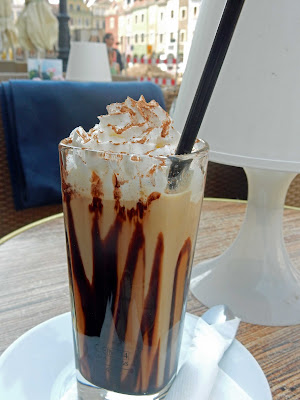

Because I had enjoyed the above about 12:00 noon, I thought a light mid-day meal was in order so I asked for the Caesar Salad with chicken.
This was very good.

In the evening I tried the pork chop entree.

Again this was a great choice.

Now I can't remember if I had the dessert below at mid-day or in the evening. Ah, the problems of travel -- so much good food, one can't remember which meal!

This was loaded with nuts and chocolate bits.

A new thing I tried another day was a typical Greek Salad with feta cheese and olives, but as you may be able to see in the photo, also watermelon. I've never thought about adding watermelon to this type of salad.


On another day I was really hungry for the mid-day meal so ordered from the weekly special menu. This dish was called Chicken Supreme.
In the evening of the same day I had an amazing hamburger.

I don't like onions so ordered it without. Instead the chef created a layer of radishes. I ate this in layers with my fork and knife. This certainly wasn't a burger one could pick up and eat like we do burgers in the United States.

Overnight there was a rain shower and the temperature cooled down into the 80s. Thus I thought my excuse was gone -- I could walk a bit. I started out to the rynek to find a restaurant for the mid-day meal. However, about two blocks from the hotel I walked by a Why Thai. There was a sign out front saying that today's special was a chicken and cashew stir fry. I was hooked.

 The restaurant is decorated in a minimalist Asian style.

Here's the stir-fry.

I finished off this meal with an ice cream.

 One might assume this is vanilla ice cream, but again it is a version of smietana. Its flavor is a bit different than vanilla. And I'm certain this is the first time I've had star fruit as the fruit with the ice cream.

So you can see, pierogi may be wonderful -- but there is so much more to eat. And it's all so very good.,


Tuesday, August 11, 2015

From Warsaw to Poznan

I am writing this blog post because I find there are many who wish to visit Poland and other Central European countries but feel they cannot do so because they do not speak the languages of Central Europe. Really, it is easy to fly to and within Central Europe. 

Last Saturday I left Reymontówka with the other team members about 8:30 in the morning. Our leaving time ensures all will make their flights back to their homes or elsewhere for their travels as well as to ensure also that the transportation back to Reymontówka is at the airport for those arriving on the next team. We arrived at the Warsaw airport about 10:00 AM. Luggage carts are readily available when one gets to an airport such as this; they are free unlike how we handle luggage carts in the United States.

My flight on last Saturday was to Poznan where I planned to visit for a few days, and I was using LOT airlines for this flight. For a LOT flight and for nearly every other airline one obtains a boarding pass by using a kiosk. This is exactly that same way that I get my boarding passes at Amsterdam Schiphol airport too. 

Next one has to check baggage. While waiting in this line I saw this billboard size poster above my head. 

The person who helped me with checking my baggage spoke very good English. One doesn't have to do this task in Polish in Poland nor in Hungarian in Hungary or in Romanian in Romania! English is spoken at nearly every international airport and also within many of the domestic airports in Central European countries. 

LOT also wished to weigh my carry-on luggage. Next comes access to the security. Now at both the Warsaw airport and Amsterdam Schiphol one gains access to this by placing the bar code of the boarding pass on a reader. 

I had plenty of time before my flight to Poznan so went looking for food. 

This is cappuccino with sernik, which is Polish cheese cake. This version  had a crust made from chocolate and nuts and then chocolate frosting on the top. What's not to love about that. If you've not had sernik before, the first serving will surprise you. It is not a rich in fat nor as sweet as most American versions of cheesecake 

Eventually I wandered to my boarding gate. It was easy to know if I was in the right area. The Warsaw airport is very modern with all digital signage. 

 Above is the sign when it appeared in Polish and below is the sign when it appeared in English. In the case of these cities the difference between Polish and English is quite subtle. 

I would just add a caution that the English spelling of the city as Cracow causes Americans to totally mispronounce it. It seems Americans too want to put an emphasis on the cow syllable. I keep saying there is no cow in that city. One American woman snottily told me, "I'll say it anyway I want to." That kind of attitude is what gives American travelers a bad rap. And I didn't correct her in any public way just quietly told her how to pronounce the name of the city. 

And the boarding gate looks like just any other boarding gate in any modern airport. 

 While waiting at the gate I spent time reading but also seeing some unique things. First a security guard came by riding on a segway. In the same area as my gate to Poznan was a gate to Kraków. One person intending to go there was priest wearing a black short sleeve shirt with a clerical collar coupled with black Bermuda shorts. That sight was a first for me -- but it surely made sense on such a hot day. And while waiting I noticed emergency medical service attendants arriving nearby, again on segways,  and checking out the vital signs on a whole family. Don't know what the story was about that for no one appeared to be in great distress.


 It is not uncommon to walk down stairs to a bus that takes one out on the tarmac to the plane We took quite a tour of the Warsaw airport before we got to the plane that took us to Poznan. 

It was a small prop jet that flew this 50 minute commuter flight. 

I quickly realized that the view to the ground might be very good. Here are a couple of pictures 


I know I'm over Poland airspace when I see the long skinny fields. Over Slovakia one sees fields shaped in rectangles and squares like one finds in the midwestern United States. And flying over the Czech Republic is way fun because there the fields have every geometric shape you can imagine. 

On this short flight we were served water and a Prince Polo bar. I had torn my open before I thought of this story that follows. 


 I first came to Poland in 2002 flying with LOT. Then we were served meals with real china and silverware. Bread was served in beautiful baskets. It was all quite elegant. But I was mystified about why the dessert, after such an elegantly presented meal, was a Tic-Tac candy bar. Then I got to Poland and discovered the love for wafer bars. Princessa is another brand of wafer candy bars that I buy here. Tic-Tac was the closest thing LOT could purchase in Chicago for the meal service back to Poland. 

In Poznan we again walked out of the plane to a bus and then were taken to the airport, 

Inside it was easy to find the right luggage belt. 

In the luggage area, too, there was advice about using a taxi. 


 The only problem I had with the taxi service is that there were more passengers wanting taxis than there were taxis. I had to wait a bit for some more to arrive and others pushed in front of me. I heard in a very proper British accent, "They don't mind queue here very much do they?" No they don't, not anywhere in Central Europe. One must be a bit more assertive in a line than I generally am when at home in Minnesota. 

So I hope this little story may help any nervous traveler to Central Europe to get here and have a very good time. This is a wonderful part of the world. 


Sunday, August 9, 2015

Teaching English with Games

Each time a team of Global Volunteers comes to Poland we meet with the County Governor because the County of Siedlce is the official host for Global Volunteers in Poland. One who has known about the work of the volunteers over about a 15 year span said last year, "We were puzzled how you could teach English with games, but now we know it works." Language camps are nothing like school except that the children must come to the classes. The older and more fluent students too have told us that they like these classes because they can try out their English and if they make a mistake it doesn't affect their mark, what we call a grade in the United States.  (Well, sometimes I try out my Polish and that earns some good laughter.)

Here are two examples to illustrate teaching with games.

One wise Polish-English teacher said, "These are kids. We can't expect to sit still and listen to us for 45 minutes." I try also to use the principle of changing activities about every 20 minutes.

In the photo above my students are putting together I Spy puzzles. You can easily see they are not sitting and listening, but are engrossed in the activity. Once the puzzles are assembled I have them look at all the figures on the puzzles and write ten English words in their notebooks. I also tell them to ask me if they find something for which they do not know the English word. Once they have the list of 10 words I ask each to sit by me for minute and individually pronounce the words in their list so I can check prounciation. Then I assign them 2-3 words from their list to use in a sentences. Once the students have completed the sentences I review them again and make any needed corrections. For example, a student may write, "I like bird." What we would say, at least where I live, is "I like birds."  I always laughed too during my work with the class when I would get a sentence from one of my girls.  I knew from the first day that she had 5 cats. Frequently she would write, "I don't like dogs."

During the two weeks the volunteers make a presentation to all the campers about their home state, their hobby, or their travel in other parts of the world. During the first two camps the volunteers present in English and then the presentation is translated in to Polish, because the campers in the first two sessions are in elementary school and have a lot of vocabulary, but still not a great deal of comprehension for complicated English sentences.

On the second to last day of camp we spent one session doing the General Knowledge Game. In this game the students are divided into groups randomly so there is a mix of the older students with the  younger students, and thus each group has a somewhat even chance to score points.

The questions included: "What day is Polish Independence Day? Write your answer in English" to "Which two volunteers have ridden their bicycles across the United States" and "In the Public Market in Seattle what food do the market attendants throw to the customer?" Each group writes the group's answer on a white board and then a signal is given is for all white boards to be raised at the same time. Thus one group can't see the answer from another group. Also every group that has the right answer scores points.

So that is how English can be taught with games and students sometimes don't even notice they are having a class.

Wednesday, August 5, 2015

An Evening Stroll out the Front Door of Reymontówka

One of my fellow Global Volunteers said yesterday, " Reymontówka is such a special place." Oh, I agree. At the completion of my stay here for this language camp I will have "lived" here for 49 weeks, so in very many ways it feels like home to me. 

The beauty of Reymontówka is one of the things that makes it so special.  Here are some photos I took on a recent evening stroll out the front door -- and with my gimpy leg a short stroll is about all I can do, so it is wonderful to see so much beauty in such a short distance. 

 When standing on the steps leading to the front door, this is the view -- the lovely circle flower bed. At the far left of the picture and in the 9:00 position one can glimpse the front gate. During language camps this gate is closed for the protection of children who may be running about. The tree is covered with bird houses.

If one is standing near the front gate this is the view of the manor house, Reymontówka.


Two pictures below show the beautiful flowers in more detail. 


The photo above shows detail from the opposite side of the front door. Presently flags are there for Poland, the European Union, and the United States. The United States flag is there right now because the language camps are a program of Global Volunteers which is an organization based in Minnesota. When events happen at Reymontówka that include guests from other countries the flag stand is modified, but of course the Polish and EU flags are always there. 

In the photo above on the far right at the 3:00 position there is a glimpse of another building. This building has two parts joined together with a small arcade. One part is an art gallery and the other part of the building are bedrooms. 

Above is a photo that shows the two wood-carved figures in greater detail. They hold a sign which provides a brief overview of the history of the manor house. 

And in a tree-lined alcove to the left of the manor house is this wood-carving. 

This wood carving has been here for perhaps now about 5 years. What cannot be seen in the picture is a bench and on the bench there is one line of music carved into the bench back from one of Chopin's composition. 

This brief stroll hopefully shows you why Reymontówka is such a special place.

A Visit to a Mushroom Farm

Each time there is a Global Volunteers program we make a visit to the County Governor (Storosta -- hopefully spelled correctly in Polish) since the County of Siedlce is the official host for the Poland Global Volunteer program.

This time our meeting was with the Deputy Governor. I met him, too, when I was here in May. The May event included a celebration of the 25th anniversary of the partnership between the County of Siedlce and Global Volunteers. In May, when we met the Deputy Governor, he shared he was in a school where the first team of Global Volunteers taught English.

In this photo the Deputy Governor is the gentleman wearing the necktie in the second row where all are standing. I'm wearing the black top in the seated room holding onto, unfortunately, a pink cane I need to use to walk these days.

One volunteer, during the meeting, asked about the agricultural products grown in this area and every volunteer but me was surprised to learn that mushrooms are a very large and important crop in this area. I knew mushrooms were important, but I didn't realize how important until last year when I couldn't find a hotel room in Siedlce when I was planning to arrive and go with the campers to the Zakopane program. The hotels in Siedlce were full because of the National Mushroom Growers' Convention. This was the first and perhaps only time ever in the future I'll be bumped out of a hotel reservation by mushrooms.

When the topic of mushrooms emerged, we were asked if we would like to visit a mushroom farm and all agreed. Thus, Marek, the director of Reymontowka -- the gentleman standing at the far left of the standing row, arranged for us to visit a mushroom farm.

In 2004 when I first came to Reymontowka I visited a mushroom farm in nearby Cisie. That mushroom farm had 4 or 5 buildings, with mushrooms growing in different stages, from just planted to almost ready for harvest. When we got to the one we visited this year, my jaw dropped. This mushroom farm had perhaps 20 buildings -- I didn't have time to count, but it was a great many.

We entered through the office area and went by areas such as the cafeteria for the workers in this mushroom farm.

We then entered a long hallway that appears to connect with all the buildings on the farm. Near the door where we entered this hallway, but inside the hallway, were machines that recorded data about the conditions such as temperature and humidity in each of the buildings.

The gentleman who owns/manages  this farm, I'm uncertain of which is the right word, explained his family has been raising mushrooms for 38 years and he has been involved with raising mushrooms for 19 years.

Some of the smaller mushroom farms in this area shut down over the summer because the temperature becomes too warm to grow mushrooms, but these buildings are all climate controlled so mushrooms can be grown year around.

The photo above shows that there are multiple shelves of mushrooms in each building. The equipment in the center can be raised and lowered to give access to mushrooms at any level for care of the mushrooms or for the picking of the mushrooms. We learned that about 100 people work on this mushroom farm -- thus you can see it is a big operation. Some volunteers noted there were few cars parked around the farm at the time we visited, about 2:30 in the afternoon, so where were the workers? That is when we learned that particularly for picking mushrooms, workers do a night shift. However, I did not learn why picking mushrooms at night is better than picking mushrooms in the morning or the afternoon,

Below is a close-up of one of the mushroom trays.


The host for our tour reached over a picked a mushroom for each of us to taste. Some of my volunteer colleagues were nervous about going on this trip thinking there would be an unpleasant odor. However, to me the smell is like soil after a nice rain. It is not unpleasant at all. And I proved to be the only one brave enough to taste one of the mushrooms. 

In this area of Poland mushrooms are sold to markets all over Europe, but due to the eastern Poland location of this particular farm a primary market has been Russia. Last year, unfortunately, the political leaders of Russia -- for what I believe are political reasons connected with the Ukrainian problem --  placed an embargo on products such as mushrooms from Poland. I have now seen some television segments in the United States that show some markets in Russia are beginning to have empty shelves from the embargo of Polish produce which includes apples, raspberries, and currants as well.

I find the Polish farmers have been creative in finding new markets for their produce, and I'm very sorry that the average Russian is being harmed by the policies of the country's leaders.

Sunday, August 2, 2015

Language Camp Continues

More fun at language camp. I continue to enjoy the  students in my individual class very much. I'm working hard on having them make complete sentences. For example, if I ask if they have a pet, they will often answer with just one word. I'm trying to get them to say instead, "I have a dog." I start every class too with completing information about what is the day of the week, what is the date, and what is the weather. I know from experience the students learn the words hot and cold in the school English classes. I try to extend their vocabulary by adding the words warm and cool. I tell them they must save cold for the days when water freezes and there is snow on the ground. Likewise we will save hot for temperatures in the high 80s or 90s (as temp is measured in Fahrenheit). They continue to like my bringing a Bingo or Jingo game for the third lesson of the day, a bit of relaxing after I've had them working so very hard in making sentences.

For the 4th English lesson we have been doing classes altogether. On Wednesday I did a presentation for all the campers during the 4th hour language lesson about Minnesota. On Thursday the two volunteers from Seattle gave a wonderful presentation about Seattle and also showed pictures about their individual adventures. For example, these volunteers, who are a married couple, rode their bicycles across the United States, starting in Yorktown, Virginia and ending in the Seattle area. This trip took them three months.On Friday we all sang together some popular songs.

On Friday evening the student activity was a game we call Blind Date in English. In Polish this has another name, Randka w Ciemno. When I pointed out to some of the campers that the R was backwards on the sign, well the K is backwards too, they told me it was not a mistake, that this did this to make the sign funny.


The game involved a boy or girl being placed on one side of a screen. If it is a boy then there are three girls -- called candidates on the other side of the screen. The candidates answer questions. However, to keep the boy guessing about who is on the other side of the screen, the girls whisper their answers to a camper acting as a game MC, and so all answers are given by one person who is not in the game. This year, too, this game was played in a bilingual fashion with all questions, answers, and announcements about the game given in both Polish and English. The questions and answers can be very funny. One group of girls was asked how they would greet the boy's parents if she went there for obiad. One girl answered she wouldn't go, she would go shopping instead!

When the "dating" couple is announced they get to draw a prize award paper out of a hat. One prize that  two campers liked was being excused from morning exercise on Monday.

Four of the volunteers went into Warsaw for some or all of the weekend, three of them went with the campers on a trip to Warsaw Zoo on Saturday, and two volunteers walked to Kotun on Satruday and had a wonderful time eating pizza at the new DaVinci pizza place there. So I was alone a good bit of the time on Saturday -- I chose to stay here because my sore knee doesn't allow me to great deal of walking yet. I had a wonderful day, taking both a morning nap and an afternoon nap. I also enjoyed doing some recreational reading.

Today Sunday is a day when parents and grandparents come to visit for a bit. Two of the counselors took several students to church. There are many visitors who make the trek to the ice cream bar located in an underground area of Reymontowka. It is just a relaxing day. 

I'm having a great time again being a teacher at language camp.