This is a blog posting primarily for those of you that live in other countries. First, let me say I'm grateful that you all find time and interest in reading what is put here.
At this time of the year things go crazy for pumpkin -- at least in the Midwest United States. Yesterday I went to a grocery store with a friend while I'm visiting in Lincoln, NE. Here are some of the pumpkin things available.
Above is pumpkin spice coffee. Popular coffee shops also sell pumpkin and spice coffee lattes this time of year.
Above is a cereal now flavored with pumpkin for the season.
More cereal above. In this case instant oatmeal. This is actually something I purchases to take home with me to home for some upcoming winter mornings.
Now if I find pumpkin bagels in my grocery store at home, I'll probably purchase them and put most in the freezer to enjoy on other upcoming winter mornings.
Now I must confess at home I already have pumpkin muffins in the freezer. But mine do not have cream cheese frosting.
I will close this out with a photo of pumpkin pie spice.
Hope you enjoy this little tour of pumpkin-flavored items.
Observations about the wonderful, unexpected, and sometimes mundane things that should be noticed and celebrated whether found two steps out the door or thousands of miles away.
Sunday, October 25, 2015
Wednesday, October 21, 2015
Finding Adventure Across the Street
The heading on this blog includes the idea that sometimes adventures are mundane. This morning I decided to go into the bedroom by the window to read for a bit. Suddenly I noticed a man crawling around by the billboard across the street.
Notice from my vantage point I'm looking down on the billboard. And notice the yellow pail on the roof behind the man. That yellow pail has been rolling around on the roof of the building across the street as long as I've lived here.
But back to the workman. I couldn't figure out what he was going to do.
Then suddenly he pulled the shield down over his face and I knew he was going to weld something.
It was fun to see the sparks fly! I still don't understand exactly what was fixed/repaired. But I saw something new today -- something I've never seem before.
Tuesday, October 20, 2015
Walking in Quamba
Those of you who follow my blog may know that my summer was different this year due to arthritis in my right leg. For awhile walking from the bedroom to the kitchen was a big trip, never mind the long walk from my apartment to the place where we put trash and recycling items. -- which is about a two block round trip. With treatment and then exercise at the Eastside YMCA things are gradually getting better. I really wanted to do the Quamba walk to mark off Q from my Walking the USA from A-Z and Walking Minnesota Cities A-Z.
So I gathered up courage and tried the Quamba walk. Quamba is located in Kanabec County. According to my Minnesota Geographic Names book Kanabec is an Ojibway word for snake. The county is named after the Snake River that winds through Kanabec and Pine counties. Later in the day I drove across the Snake River and agreed with the name, for it really winds.
Quamba has only 123 people, so the walk box for this walk is located in nearby Mora. I enjoyed the drive to Mora through the rural country. The trees were beautiful and also saw waterfowl gathered in small lakes for their migration. From Mora it was about 6 mile drive to Quamba. Quamba was given its name by railroad officers. Wikipedia says it is a translation from the Ojibway word for mudhole! This town originated as a side track location for the Great Northern Railroad. That is all gone now.
Since I had picked up the route for the walk in Mora, when I got to Quamba I drove a bit of it, so I didn't make mistakes with my walking with my somewhat sore leg. I had checked with American Volksmarch and learned I didn't have to walk the entire 5K or 10K route to count this walk for event books, but of course I had to honest about the distance I walked.
I parked my card at the south end of the mostly vacant business area.
The town has a church and a city hall.
Here is a view of one of three streets in the town.
I found the "post office."
One of the best things of this walk was Mother Nature.
And here is the final part of my walk. It was interesting because the stones on this trail were quite varied and beautiful.
My pink cane and I were glad to see my car which is parked at the end of this road. I did a whole 2 K for this walk, Now only X to do for the USA book.
So I gathered up courage and tried the Quamba walk. Quamba is located in Kanabec County. According to my Minnesota Geographic Names book Kanabec is an Ojibway word for snake. The county is named after the Snake River that winds through Kanabec and Pine counties. Later in the day I drove across the Snake River and agreed with the name, for it really winds.
Quamba has only 123 people, so the walk box for this walk is located in nearby Mora. I enjoyed the drive to Mora through the rural country. The trees were beautiful and also saw waterfowl gathered in small lakes for their migration. From Mora it was about 6 mile drive to Quamba. Quamba was given its name by railroad officers. Wikipedia says it is a translation from the Ojibway word for mudhole! This town originated as a side track location for the Great Northern Railroad. That is all gone now.
Since I had picked up the route for the walk in Mora, when I got to Quamba I drove a bit of it, so I didn't make mistakes with my walking with my somewhat sore leg. I had checked with American Volksmarch and learned I didn't have to walk the entire 5K or 10K route to count this walk for event books, but of course I had to honest about the distance I walked.
I parked my card at the south end of the mostly vacant business area.
Here is a view of one of three streets in the town.
I found the "post office."
One of the best things of this walk was Mother Nature.
And here is the final part of my walk. It was interesting because the stones on this trail were quite varied and beautiful.
My pink cane and I were glad to see my car which is parked at the end of this road. I did a whole 2 K for this walk, Now only X to do for the USA book.
Sunday, October 4, 2015
Adventure in Learning about our Hmong neighbors
Saint Paul has the largest Hmong population than any other city in the United States. I thought I knew about Hmong culture until I went to the exhibit today at the Minnesota History Center. This exhibit marks the 40th anniversary of the Hmong arrival to Minnesota.
Today my older daughter, who lives in a group home, had an appointment for a haircut. However about 2 hours before the appointment her hairdresser called and said her appointments today were running behind and she asked if we could come next week. So we decided to have lunch together and then go to the History Center. Below is the beautiful autumn view that greeted us.
In the exhibit we found a chronology of the Hmong people and their culture. The Hmong culture goes back at least 6000 years.
According to the information I found, the Hmong, then located in what is present day southern China, were the first farmers of rice in the entire world, and then obviously the growth of rice spread into many places.
During the above interval of time, the Hmong as well as other ethnic minorities were forced about China. The Hmong relocated primarily into what is present day Laos.
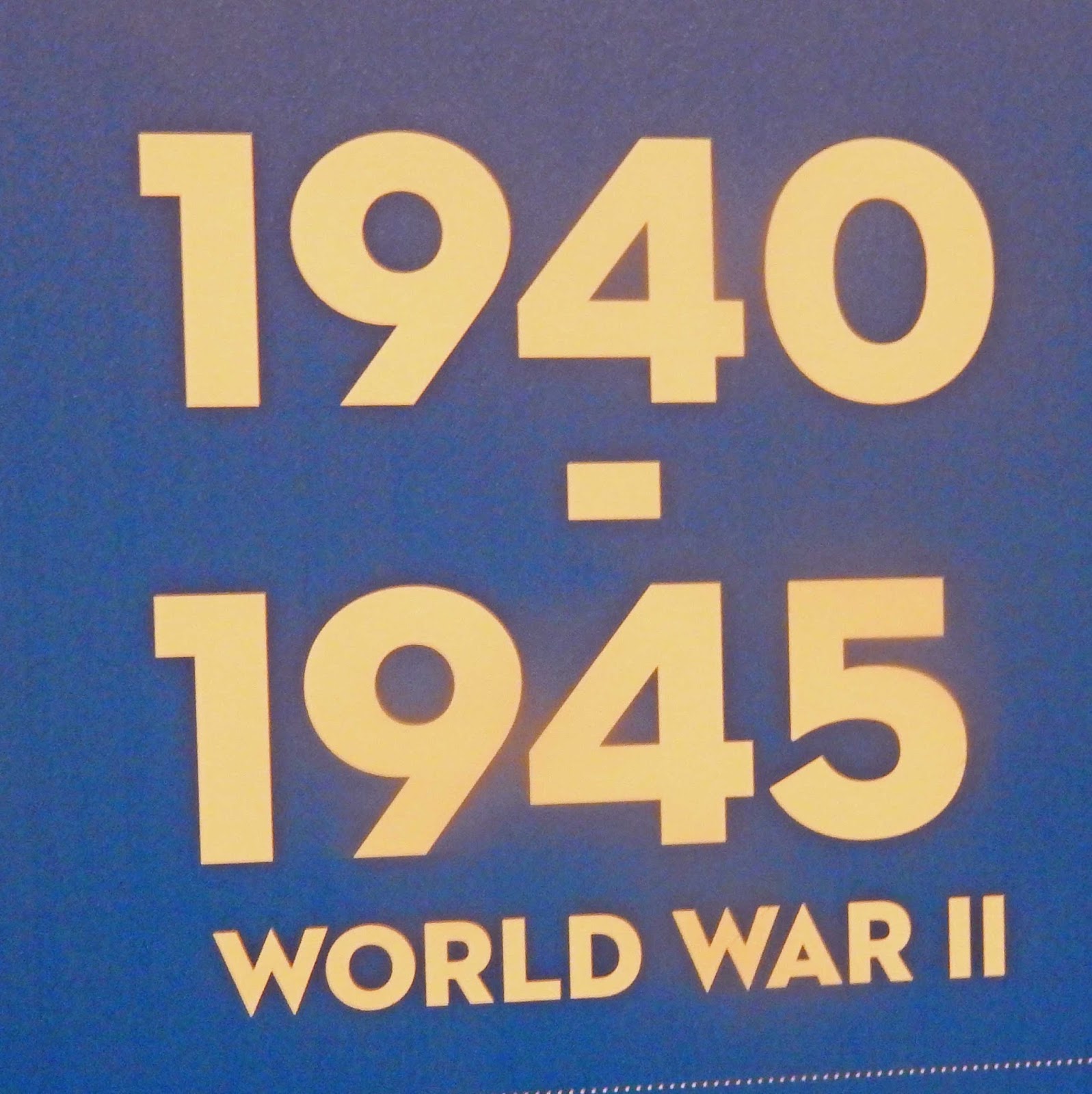
Beginning with the era above the next 30+ years were a time of constant warfare for the Hmong. The time most in the world call World War II was called the Japanese War by the Hmong. Most fought in Laos on the side of the France, the country which at that time was in control of what is present day Laos. When World War II was over the area moved into what is called the IndoChina War. When France left this area, the governments of present day Laos and Viet Nam were leaning to Communism.
Much to my amazement I learned that in the early 1960s the CIA established a huge military base in present day Laos and it was staffed primarily by Hmong soldiers and staff. This is part of what is called the Secret War, and was authorized by President Kennedy as a way to fight back against Communist governments. Indeed as far as I'm concerned, it was a Secret War.
Below is a model. I am sorry that the picture is not very good. There was no way I could avoid the reflection of the overhead lights.
It was called Long Cheng. The exhibit notes said it was also known by a code name, Lima Site. By 1966 it was one of very largest air bases in the world.
Surrounding this exhibit area are objects associated with Hmong military service. Below, for example, is a beret.
I have known for some time that the Hmong fought on the side the U.S. during the Viet Nam war, but had no idea that the Hmong involvement with the U.S. government went back as far as the early 1960s and in Laos besides
When the U.S. left South Asia the Hmong were in a bad position with the assuming Communist governments in Laos and Viet Nam and needed to flee the area. Their status obviously met the qualification of refugee in U.S law.
But first came the paperwork. The display below shows the type of documents that had to be completed.
The paper hurdle is not a joke. The last Hmong refugees arrived somewhat more than 5 years ago. This population had lived in a nonofficial refugee camp in Thailand. For this population, anyone less than 25 years old had lived their whole life in this nonofficial refugee camp. Minnesota was expecting 5000 to arrive. A doctor who would be in charge initially of their health care went to the camp in Thailand and came home with this story: She met a man who had pervasive bladder cancer and was in extreme pain. He was refusing to take any medications for his severe pain. Why? He was afraid that if he tested positive for using a drug that his entire family would be prevented from leaving the camp for Minnesota.
The Hmong used oral language to keep their culture alive, along with what are called story cloths. The exhibit has a display of one that is very large.
I took the above photo at an angle trying to avoid reflections from the overhead lights.
Below are some photos that show details from this story cloth
I was fascinated with the part of the story cloth for I have had university students tell me they remember hanging on to their parents' backs as they swam across the Mekong River to safety.
The photo above shows that without regard to their location the Hmong are talented farmers.
Since I spend much time teaching English I, of course, had to make note of this part of the story cloth.
And this portion of the story cloth makes note that people did leave
The exhibit explains that each person who was leaving a refugee camp was given a small plastic box in which to put things they wished to bring with them to the United States. These varied from the T-shirt shown below
to a very beautiful silver necklace.
Why did so many come to Minnesota? The exhibit says it because Minnesota has very effective social service agencies to arriving people. But we must recognize Hmong also moved to Australia, Argentina, Canada, France, French Guiana, and Germany
What did the Hmong think of Minnesota? On one sign at the exhibit I found this statement: St Paul could have been the moon. The language, the climate, the plants, the money, the values, the technology the house -- nothing made sense.
There were many bumps in the road. For example, housing was difficult to find because many landlords required a two year rental history. The arriving Hmong wondered how they could do this when they had been living in a refugee camp. Rules such as this had to modified.
Part of the exhibit moved us too to a Home exhibit. The History Center has an exhibit about a house at 402 Hopkins that has been the home for succeeding groups of immigrants and refugees. First were Germans, then Italians, and then Hmong in this house. The Hmong living room proved to be very simple in its design.
It includes a Hmong altar.
Signage by the altar explained the symbol of the articles found on it. For example, an egg is a symbol of new life, a symbol an egg occupies in many culture.
And on one wall is the example of a beautiful tapestry.
Now about 40% of the students in the Saint Paul schools are Hmong kids. Sometimes, for example when shopping in Target, I will hear a child say "Mom" with the exact same intonation that my kids used when they were little.
Hmong have moved into all kinds of professions and also into elected positions with local and state government.
Because this culture was highly based on agriculture, many have moved into small farming. These farms are now a major source of the products that move into Farmers' Markets during the spring, summer, and fall.
The ending of the exhibit has bowls of plastic vegetables and fruits labeled with bar codes. When one places the bar code on the reader a nearby monitor plays a video that shows how the fruit or vegetable is used in Hmong cooking.
This is a great exhibit. I do hope that anyone close to Minnesota comes by to see this exhibit. It shows what happens when a new population comes to a place -- how things are the same or different after 40 years!
Today my older daughter, who lives in a group home, had an appointment for a haircut. However about 2 hours before the appointment her hairdresser called and said her appointments today were running behind and she asked if we could come next week. So we decided to have lunch together and then go to the History Center. Below is the beautiful autumn view that greeted us.
In the exhibit we found a chronology of the Hmong people and their culture. The Hmong culture goes back at least 6000 years.
According to the information I found, the Hmong, then located in what is present day southern China, were the first farmers of rice in the entire world, and then obviously the growth of rice spread into many places.
During the above interval of time, the Hmong as well as other ethnic minorities were forced about China. The Hmong relocated primarily into what is present day Laos.
Beginning with the era above the next 30+ years were a time of constant warfare for the Hmong. The time most in the world call World War II was called the Japanese War by the Hmong. Most fought in Laos on the side of the France, the country which at that time was in control of what is present day Laos. When World War II was over the area moved into what is called the IndoChina War. When France left this area, the governments of present day Laos and Viet Nam were leaning to Communism.
Much to my amazement I learned that in the early 1960s the CIA established a huge military base in present day Laos and it was staffed primarily by Hmong soldiers and staff. This is part of what is called the Secret War, and was authorized by President Kennedy as a way to fight back against Communist governments. Indeed as far as I'm concerned, it was a Secret War.
Below is a model. I am sorry that the picture is not very good. There was no way I could avoid the reflection of the overhead lights.
It was called Long Cheng. The exhibit notes said it was also known by a code name, Lima Site. By 1966 it was one of very largest air bases in the world.
Surrounding this exhibit area are objects associated with Hmong military service. Below, for example, is a beret.
I have known for some time that the Hmong fought on the side the U.S. during the Viet Nam war, but had no idea that the Hmong involvement with the U.S. government went back as far as the early 1960s and in Laos besides
When the U.S. left South Asia the Hmong were in a bad position with the assuming Communist governments in Laos and Viet Nam and needed to flee the area. Their status obviously met the qualification of refugee in U.S law.
But first came the paperwork. The display below shows the type of documents that had to be completed.
The paper hurdle is not a joke. The last Hmong refugees arrived somewhat more than 5 years ago. This population had lived in a nonofficial refugee camp in Thailand. For this population, anyone less than 25 years old had lived their whole life in this nonofficial refugee camp. Minnesota was expecting 5000 to arrive. A doctor who would be in charge initially of their health care went to the camp in Thailand and came home with this story: She met a man who had pervasive bladder cancer and was in extreme pain. He was refusing to take any medications for his severe pain. Why? He was afraid that if he tested positive for using a drug that his entire family would be prevented from leaving the camp for Minnesota.
The Hmong used oral language to keep their culture alive, along with what are called story cloths. The exhibit has a display of one that is very large.
I took the above photo at an angle trying to avoid reflections from the overhead lights.
Below are some photos that show details from this story cloth
I was fascinated with the part of the story cloth for I have had university students tell me they remember hanging on to their parents' backs as they swam across the Mekong River to safety.
The photo above shows that without regard to their location the Hmong are talented farmers.
Since I spend much time teaching English I, of course, had to make note of this part of the story cloth.
And this portion of the story cloth makes note that people did leave
The exhibit explains that each person who was leaving a refugee camp was given a small plastic box in which to put things they wished to bring with them to the United States. These varied from the T-shirt shown below
to a very beautiful silver necklace.
Why did so many come to Minnesota? The exhibit says it because Minnesota has very effective social service agencies to arriving people. But we must recognize Hmong also moved to Australia, Argentina, Canada, France, French Guiana, and Germany
What did the Hmong think of Minnesota? On one sign at the exhibit I found this statement: St Paul could have been the moon. The language, the climate, the plants, the money, the values, the technology the house -- nothing made sense.
There were many bumps in the road. For example, housing was difficult to find because many landlords required a two year rental history. The arriving Hmong wondered how they could do this when they had been living in a refugee camp. Rules such as this had to modified.
Part of the exhibit moved us too to a Home exhibit. The History Center has an exhibit about a house at 402 Hopkins that has been the home for succeeding groups of immigrants and refugees. First were Germans, then Italians, and then Hmong in this house. The Hmong living room proved to be very simple in its design.
It includes a Hmong altar.
Signage by the altar explained the symbol of the articles found on it. For example, an egg is a symbol of new life, a symbol an egg occupies in many culture.
And on one wall is the example of a beautiful tapestry.
Now about 40% of the students in the Saint Paul schools are Hmong kids. Sometimes, for example when shopping in Target, I will hear a child say "Mom" with the exact same intonation that my kids used when they were little.
Hmong have moved into all kinds of professions and also into elected positions with local and state government.
Because this culture was highly based on agriculture, many have moved into small farming. These farms are now a major source of the products that move into Farmers' Markets during the spring, summer, and fall.
The ending of the exhibit has bowls of plastic vegetables and fruits labeled with bar codes. When one places the bar code on the reader a nearby monitor plays a video that shows how the fruit or vegetable is used in Hmong cooking.
This is a great exhibit. I do hope that anyone close to Minnesota comes by to see this exhibit. It shows what happens when a new population comes to a place -- how things are the same or different after 40 years!
Saturday, October 3, 2015
Going to Hawaii on Foot
Can one walk from Minnesota to Hawaii? Certainly no! But last week my arthritis had improved so much that I could walk a bit. I received e-mail that the Rose Ensemble would be performing at the J. J. J. Hill Library. I drove to the Science Museum and parked there to lessen the distance I would have to walk.
Let's start first however to explain the Rose Ensemble. This is a wonderful music group that explores the culture of the music that they perform. We were to hear parts of a concert called the Last Queen of Hawaii, and what I call "exploring the culture" means they went to the Bishop Museum in Honolulu to work with original manuscripts for music.
Now about the J. J. Hill Library. This building ajoins the Central Library in downtown Saint Paul. It is considered a Business Reference Library. People now think everything is available on the web, but this library still maintains current literature and now also has historical holdings regarding business and leadership.
Here's the view I had as I exited the lobby of the Science Museum where I used the parking ramp (which in most to the states called parking garage) but I speak Minnesota English!
The flowers on the plaza certainly look like autumn as well as beautiful. The Central Library and the J.J. Hill Library is the white building in the background.
The inside of the J.J. Hill Library is very classical.
At the concert I was in the very back of the seating area but sitting on a sofa. Not often can one sit on a sofa at a concert.
The musicians started by thanking the Friends of the Library for this site for this concert. They said using a library site is quite unique. They said in other cities/towns when they ask perhaps for a library site for a concert everyone thinks that is very strange.
The concert began with chants done in native Hawaiian language. This was followed by hymns sung in native Hawaiian. The musicians explained we might know the melodies and even the words for the hymns, but the words that we know were not translated into native Hawaiian. Instead the language was changed, for example: Stop worshiping false gods. I certainly don't know any English hymn that has such language.
Next came cowboy songs, panioli. To place these songs into the culture the musicians explained that Vancouver brought cattle to Hawaii. Cattle were not native at all to Hawaii. After running wild for awhile, the Hawaiian King decided something had to be done and recruited cowboys from Mexico and California -- which at that time was not yet California. These all spoke Spanish -- espana, but the native Hawaiian language doesn't have a s sound so the Hawaiian language started calling the pana and the music began panalio -- a word I've probably spelled wrong. This music I would call ear candy. It is beautiful. It is very different from the Western cowboy music that we hear in English.
Next the concert moved to the hulu. One of the musicians taught the audience how to use their arms for a hulu -- four different stanzas of a hulu.
The concert closed with Aloha Oe. This song was written by the last Queen of Hawaii -- Queen Lili'okalani. That she was the last Queen of Hawaii is a sad piece of American history. And in my opinion part of another era when business owners were in charge of the American government. The Rose Ensemble found the Queen's original manuscript in the Bishop Museum and are performing it in the original form.
After the concert I walked back to the Science Museum and sat down in the Java Cafe for a cup of cappuccino.
This was the first time I'd really been able to do anything with my gimpy leg for several weeks so that is why the blog has been so silent for the past several weeks. The hip injection must have been done with magic juice for I truly feel much better.
Let's start first however to explain the Rose Ensemble. This is a wonderful music group that explores the culture of the music that they perform. We were to hear parts of a concert called the Last Queen of Hawaii, and what I call "exploring the culture" means they went to the Bishop Museum in Honolulu to work with original manuscripts for music.
Now about the J. J. Hill Library. This building ajoins the Central Library in downtown Saint Paul. It is considered a Business Reference Library. People now think everything is available on the web, but this library still maintains current literature and now also has historical holdings regarding business and leadership.
Here's the view I had as I exited the lobby of the Science Museum where I used the parking ramp (which in most to the states called parking garage) but I speak Minnesota English!
The flowers on the plaza certainly look like autumn as well as beautiful. The Central Library and the J.J. Hill Library is the white building in the background.
The inside of the J.J. Hill Library is very classical.
At the concert I was in the very back of the seating area but sitting on a sofa. Not often can one sit on a sofa at a concert.
The musicians started by thanking the Friends of the Library for this site for this concert. They said using a library site is quite unique. They said in other cities/towns when they ask perhaps for a library site for a concert everyone thinks that is very strange.
The concert began with chants done in native Hawaiian language. This was followed by hymns sung in native Hawaiian. The musicians explained we might know the melodies and even the words for the hymns, but the words that we know were not translated into native Hawaiian. Instead the language was changed, for example: Stop worshiping false gods. I certainly don't know any English hymn that has such language.
Next came cowboy songs, panioli. To place these songs into the culture the musicians explained that Vancouver brought cattle to Hawaii. Cattle were not native at all to Hawaii. After running wild for awhile, the Hawaiian King decided something had to be done and recruited cowboys from Mexico and California -- which at that time was not yet California. These all spoke Spanish -- espana, but the native Hawaiian language doesn't have a s sound so the Hawaiian language started calling the pana and the music began panalio -- a word I've probably spelled wrong. This music I would call ear candy. It is beautiful. It is very different from the Western cowboy music that we hear in English.
Next the concert moved to the hulu. One of the musicians taught the audience how to use their arms for a hulu -- four different stanzas of a hulu.
The concert closed with Aloha Oe. This song was written by the last Queen of Hawaii -- Queen Lili'okalani. That she was the last Queen of Hawaii is a sad piece of American history. And in my opinion part of another era when business owners were in charge of the American government. The Rose Ensemble found the Queen's original manuscript in the Bishop Museum and are performing it in the original form.
After the concert I walked back to the Science Museum and sat down in the Java Cafe for a cup of cappuccino.
This was the first time I'd really been able to do anything with my gimpy leg for several weeks so that is why the blog has been so silent for the past several weeks. The hip injection must have been done with magic juice for I truly feel much better.
Sunday, September 13, 2015
Mano a Mano Adventures
I have been volunteering for many years for an organization, Mano a Mano, which has its US base here in Saint Paul --- and does amazing work in Bolivia, primarily with indigenous people, who have many needs in areas with huge geographic challenges -- mountain villages at 4000 meters for example.
This organization began by collecting medical supplies that were being disposed of by hospitals, clinics, and individuals. Now the organization also builds health clinics, schools, teacher housing, reservoirs, and roads. It truly is a Non-Governmental Organization. For my international readers, that is a term used to describe an organization that does activities usually associated with work that should be done by the government.
Here is Minnesota we sort medical supplies that have been gathered primarily from the Twin Cities area. However, there is a group from North Dakota that also gathers and then ships things to Saint Paul for Mano a Mano.
Boxes usually have a mixture of things and we dump them out on a table and then begin to sort them into 12 categories of materials. Volunteers from many different organizations and even without any connection to an organization -- just people with good hearts -- help to do all this sorting. For example, I have often shared a sorting session with a high school student who shows up after school on afternoons. Also this year two volunteers sponsored a soup and sort -- one made a big container of soup and then other volunteers would show up between 5:00 - 6:00 in the evening, enjoy a bowl of soup and then help sort for about 2 - 2.5 hours more.
Boxes are loaded on a pallet and then wrapped in packing plastic, too, so the boxes don't fall off the pallets during the storage and shipping processes.
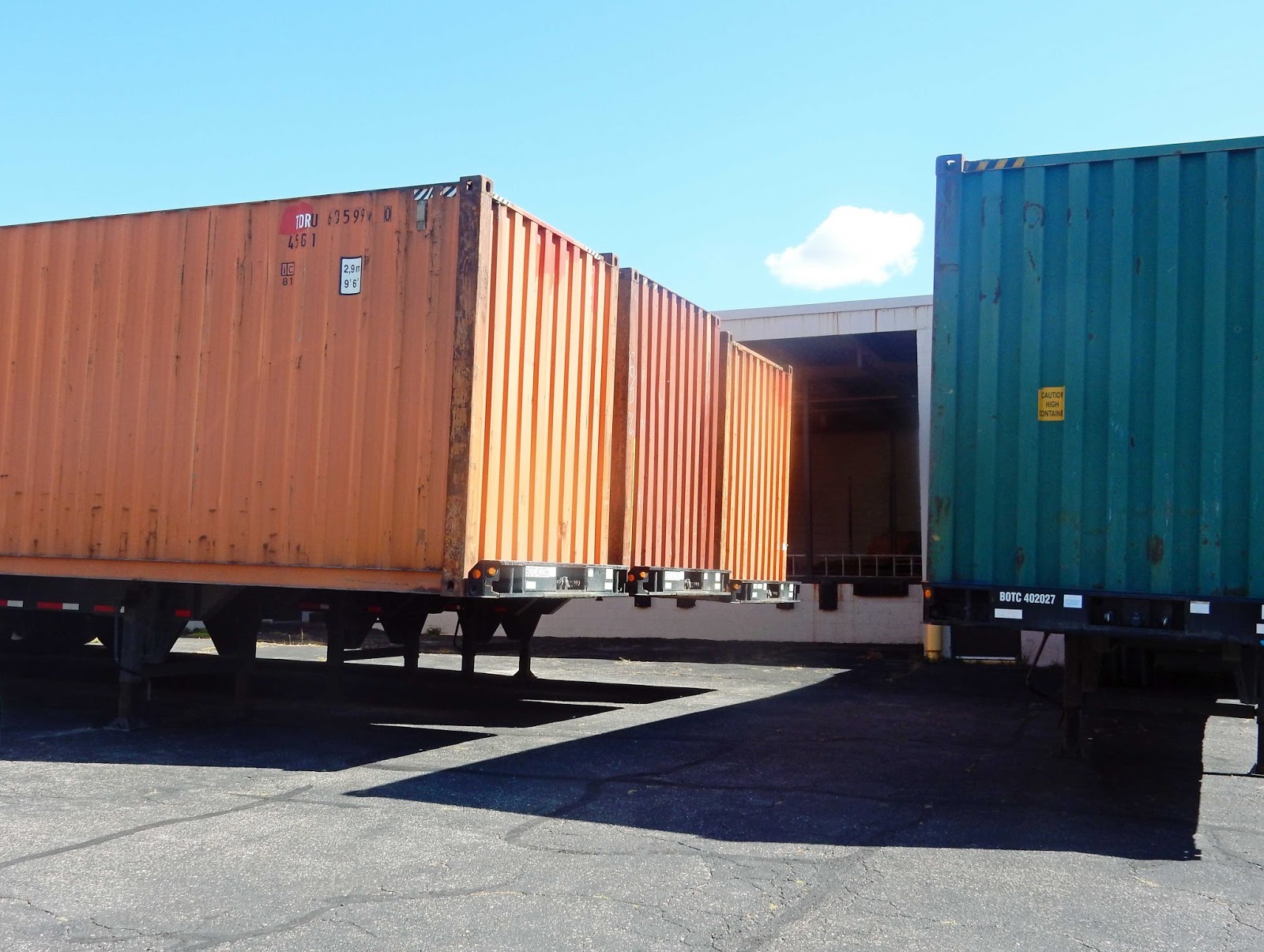
When Mano a Mano has raised enough funds to pay for the shipping then there is container loading. This happens about once a year.
First containers are brought to the Mano a Mano warehouse.
Then the loading begins.
Once a foundation is built, then wheelchairs, walkers, and crutches are loaded on the top.
My job was to make sure I got a record for everything that was loaded. On the box shown in the picture one can see a paper label. A matching one is kept in the Mano a Mano office and used to generate the final manifest that will accompany each container as it makes it way to Bolivia.
Here's a full container.
It took Thursday afternoon and all day Friday to load the four containers.
On Saturday afternoon there was a picnic. A wonderful volunteer brought a pizza oven and made pizza on site.
It was a great three days when many volunteer hours came together into four containers! Now it all will soon start again!
This organization began by collecting medical supplies that were being disposed of by hospitals, clinics, and individuals. Now the organization also builds health clinics, schools, teacher housing, reservoirs, and roads. It truly is a Non-Governmental Organization. For my international readers, that is a term used to describe an organization that does activities usually associated with work that should be done by the government.
Here is Minnesota we sort medical supplies that have been gathered primarily from the Twin Cities area. However, there is a group from North Dakota that also gathers and then ships things to Saint Paul for Mano a Mano.
Boxes usually have a mixture of things and we dump them out on a table and then begin to sort them into 12 categories of materials. Volunteers from many different organizations and even without any connection to an organization -- just people with good hearts -- help to do all this sorting. For example, I have often shared a sorting session with a high school student who shows up after school on afternoons. Also this year two volunteers sponsored a soup and sort -- one made a big container of soup and then other volunteers would show up between 5:00 - 6:00 in the evening, enjoy a bowl of soup and then help sort for about 2 - 2.5 hours more.
Boxes are loaded on a pallet and then wrapped in packing plastic, too, so the boxes don't fall off the pallets during the storage and shipping processes.
When Mano a Mano has raised enough funds to pay for the shipping then there is container loading. This happens about once a year.
First containers are brought to the Mano a Mano warehouse.
Then the loading begins.
Once a foundation is built, then wheelchairs, walkers, and crutches are loaded on the top.
My job was to make sure I got a record for everything that was loaded. On the box shown in the picture one can see a paper label. A matching one is kept in the Mano a Mano office and used to generate the final manifest that will accompany each container as it makes it way to Bolivia.
Here's a full container.
It took Thursday afternoon and all day Friday to load the four containers.
On Saturday afternoon there was a picnic. A wonderful volunteer brought a pizza oven and made pizza on site.
It was a great three days when many volunteer hours came together into four containers! Now it all will soon start again!
Monday, September 7, 2015
From Poznan to Minnesota
All good things must come to an end. On Friday, August 14 I checked out of the PURO Hotel in Poznan and took a very nice taxi ride to the airport. The taxi ride took my by many buildings so I could get an idea about the style in Poznan, by the zoo, by all kinds of interesting things.
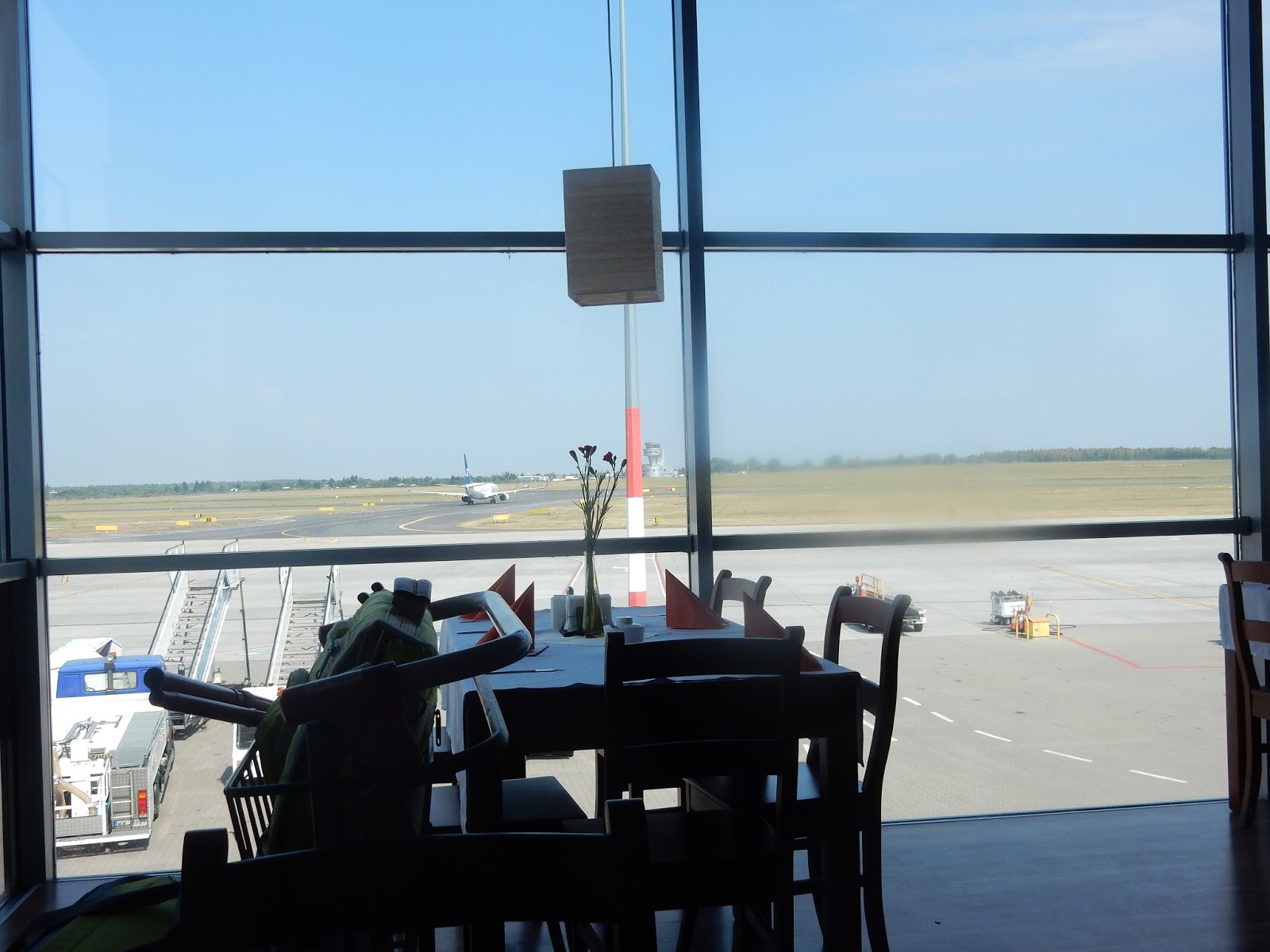
Arriving at the airport, I found a luggage cart and loaded on my bag and then found the restaurant there. I knew if would be long time before supper in Warsaw. This airport restaurant indeed has a view.
I ordered a naleśniki (perhaps spelled wrong, I have trouble with that word) with fruit. Oh my was it good! Inside it was loaded with summer fruits. Yum, yum! If I go back to Poznan I will go early to the airport just to stop at this restaurant.
When it became time to board the bus for the plane -- no jetways at this airport -- I found the step a bit high, but people on the bus helped me. A woman quickly got up to give me a seat. A very nice man carried my computer bag for me.
The flight to Warsaw was a bit bumpy, perhaps to be expected in the super heated air of that week. The same nice man helped me off the bus when we arrived in Warsaw and carried my bag inside. Then he left for the transfer area.
Arrived in Warsaw and found my suitcase was the only one of the luggage belt. Everyone else must have been on a flight transfer to somewhere else.Walked myself over to the Courtyard by Marriott. Took myself down to the Lobby Bar and ordered a turkey club sandwich. After that it wasn't too long until I crashed in bed. The next morning I enjoyed a nice breakfast and then lingered in the hotel until about the 12:00 check out time, for my flight to Amsterdam wasn't until 5:15 in the afternoon.
It turned out to be a very long afternoon at the airport, primarily because the KLM computer system went down for about 45 minutes and we all just stood there in a line trying to check in our baggage. The kiosks for getting a boarding pass continued to work OK.
Finally came the time to go through security and get to the boarding gate. I noticed a new type of food court area near this gate. It will be my good-to place on any future time I fly from this gate area. It contains a number of fast food restaurants. Mostly I was just interested in a cold slushy drink on this hot day.
One goes through a special entrance and is given a card, like a credit card. It is shown at the right in the picture. Then one can make purchases from one or more of the restaurants in the area. Then when exiting you may at a cash kiosk for everything at one time. Ingenious.
Up to Amsterdam without any problems. I noticed I felt stronger on the walk from the baggage area to the Citizen M hotel. Checked in and when it was noticed I was using a cane, the staff person helped me change the room to one closer to the elevator.
When organized in my room I went downstairs to check out the buffet. I chose penne pasta with a very good red sauce including spicy meatballs. I like Polish food but this spaghetti was a nice change. Because I have a Citizen M membership number I get a free drink so used my token for a good cold glass of Dutch beer. With the level of pain meds I'm taking I'm to avoid drinking much alcohol, but this marks only my second beer for the whole year, so I think I'm following the "not much alcohol" rule OK.
The next morning I was down for breakfast early. Then off to the airport again on cool rainy morning, which felt good after the extreme heat of the Central Europe. (Since coming home I've seen a news story that says July 2015 was the hottest July on record, and particularly hot in Central Europe. So I lived through that in July and the coldest and rainiest May in 30 years on my earlier trip this year! )
I had to sit and rest a bit on the long walk to departure hall 2. I think the long day in the airport in Warsaw and then the long walk from Arrival 2 to the Citizen M fatigued my knees quite a bit.
Right now the Amsterdam airport is undergoing renovation and leaving is an adventure. After checking in my luggage I was directed to another desk where it was verified I had a passport in hand. This visual inspection is now occurring even though one verifies passport in hand when getting the boarding pass. Then I was given the actual boarding gate for the flight. Right now Delta only announces D1 or E1 as the gate for the flight. There is where the passengers without Sky Priority Boarding do the second passport check. Only after the second passport check does one know the real boarding gate.
When we got on the plane the entertainment center for each step was working, at least for the flight data.
While on the tarmac the flight data showed we were 10 meters below sea level. And last year in Bolivia I experienced life at 4200 meters above sea level.
Our flight back to Minnesota went by a very different route. Usually we begin to cross the UK at Newcastle and fly west across Glasgow. Instead we proceeded north along England and Scotland and then turned west between Scotland and the Orkney Island. That meant we flew north of Iceland and then across the southern one-third of Greenland.
Note the advertisement for Marriott on the bottom of the screen. No matter what I did I could not get rid of it.
We entered Canada at the mouth of the St. Lawrence River. About an hour later we started the angle down to Minnesota.
On this flight I was in the middle where there are 4 seats in a row and in the aisle seat. Not to my surprise the man next to me had to get up during the flight to use the toilet. That didn't surprise me but when he came back he certainly did surprise me. I started to get up to let him get back to his seat, he motioned for me to stay in my seat. He simply picked up one leg and then the other and climbed right over me.
My granddaughter was to meet me, and she wasn't there. I called her and only got voice mail. Finally I called her boyfriend and she answered and said she would be right there, that she didn't have her phone. Later I found they had sent me a Facebook message asking my arrival time. But they sent it while I was in the air so that wasn't very helpful.
Finally got home and found my granddaughter had put all my bed lines in the washer with soap all over them, but never turned the washer on. I was just longing to go to bed, but instead I add to wait until the washer and dryer had finished with the bed linens.
But I only found this out after first I gone with her to Urgent Care. So it was a long day before I finally got to bed after getting up in Amsterdam.
I always say I like to be other places but I don't much like travel anymore. But it is definitely worth all the hassle to help the kids in Poland learn English.
It turned out to be a very long afternoon at the airport, primarily because the KLM computer system went down for about 45 minutes and we all just stood there in a line trying to check in our baggage. The kiosks for getting a boarding pass continued to work OK.
Finally came the time to go through security and get to the boarding gate. I noticed a new type of food court area near this gate. It will be my good-to place on any future time I fly from this gate area. It contains a number of fast food restaurants. Mostly I was just interested in a cold slushy drink on this hot day.
One goes through a special entrance and is given a card, like a credit card. It is shown at the right in the picture. Then one can make purchases from one or more of the restaurants in the area. Then when exiting you may at a cash kiosk for everything at one time. Ingenious.
Up to Amsterdam without any problems. I noticed I felt stronger on the walk from the baggage area to the Citizen M hotel. Checked in and when it was noticed I was using a cane, the staff person helped me change the room to one closer to the elevator.
When organized in my room I went downstairs to check out the buffet. I chose penne pasta with a very good red sauce including spicy meatballs. I like Polish food but this spaghetti was a nice change. Because I have a Citizen M membership number I get a free drink so used my token for a good cold glass of Dutch beer. With the level of pain meds I'm taking I'm to avoid drinking much alcohol, but this marks only my second beer for the whole year, so I think I'm following the "not much alcohol" rule OK.
The next morning I was down for breakfast early. Then off to the airport again on cool rainy morning, which felt good after the extreme heat of the Central Europe. (Since coming home I've seen a news story that says July 2015 was the hottest July on record, and particularly hot in Central Europe. So I lived through that in July and the coldest and rainiest May in 30 years on my earlier trip this year! )
I had to sit and rest a bit on the long walk to departure hall 2. I think the long day in the airport in Warsaw and then the long walk from Arrival 2 to the Citizen M fatigued my knees quite a bit.
Right now the Amsterdam airport is undergoing renovation and leaving is an adventure. After checking in my luggage I was directed to another desk where it was verified I had a passport in hand. This visual inspection is now occurring even though one verifies passport in hand when getting the boarding pass. Then I was given the actual boarding gate for the flight. Right now Delta only announces D1 or E1 as the gate for the flight. There is where the passengers without Sky Priority Boarding do the second passport check. Only after the second passport check does one know the real boarding gate.
When we got on the plane the entertainment center for each step was working, at least for the flight data.
While on the tarmac the flight data showed we were 10 meters below sea level. And last year in Bolivia I experienced life at 4200 meters above sea level.
Our flight back to Minnesota went by a very different route. Usually we begin to cross the UK at Newcastle and fly west across Glasgow. Instead we proceeded north along England and Scotland and then turned west between Scotland and the Orkney Island. That meant we flew north of Iceland and then across the southern one-third of Greenland.
Note the advertisement for Marriott on the bottom of the screen. No matter what I did I could not get rid of it.
We entered Canada at the mouth of the St. Lawrence River. About an hour later we started the angle down to Minnesota.
On this flight I was in the middle where there are 4 seats in a row and in the aisle seat. Not to my surprise the man next to me had to get up during the flight to use the toilet. That didn't surprise me but when he came back he certainly did surprise me. I started to get up to let him get back to his seat, he motioned for me to stay in my seat. He simply picked up one leg and then the other and climbed right over me.
My granddaughter was to meet me, and she wasn't there. I called her and only got voice mail. Finally I called her boyfriend and she answered and said she would be right there, that she didn't have her phone. Later I found they had sent me a Facebook message asking my arrival time. But they sent it while I was in the air so that wasn't very helpful.
Finally got home and found my granddaughter had put all my bed lines in the washer with soap all over them, but never turned the washer on. I was just longing to go to bed, but instead I add to wait until the washer and dryer had finished with the bed linens.
But I only found this out after first I gone with her to Urgent Care. So it was a long day before I finally got to bed after getting up in Amsterdam.
I always say I like to be other places but I don't much like travel anymore. But it is definitely worth all the hassle to help the kids in Poland learn English.
Subscribe to:
Posts (Atom)