Shortly I'll be taking a train to Budapest and then flying to Targu Mures in Romania tomorrow. I'm going there to work with a University of Pecs doctoral nursing student who is presently unable to come to Pecs. I'm so looking forward to meeting her. She has arranged a very nice place for me to stay and also has arranged for a driver to pick me up at the airport. On Sunday she will show me around the city. I'm uncertain what my Internet access will be while I'm in Targu Mures.
Yesterday I got some Romanian currency. It is beautiful and unique. Probably to make counterfeiting harder, each bill has a transparent area. One can literally see through the opening. I suspect counterfeiting is present in Central Europe because I notice any bill larger than 1000 forints is put under a scanner to look for marks that emerge.
Time is passing quickly, particularly when a great adventure such as this suddenly appears.
Friday, May 14, 2010

Thursday, May 13, 2010
A Request to Readers
In late May and early June I will be meeting with students in high schools in Pecs to discuss blogging. This activity is being coordinated by American Corners-Pecs and I'm excited to have a chance to learn more about high school education in Hungary.
Now to the request -- if you read my blog, I would appreciate knowing what you have learned about Hungary or how your ideas about Hungary or Central Europe have been changed. Please add a comment to the blog or send me an e-mail. It will make the presentation much better if I hear from many of you. Thank you.
Now to the request -- if you read my blog, I would appreciate knowing what you have learned about Hungary or how your ideas about Hungary or Central Europe have been changed. Please add a comment to the blog or send me an e-mail. It will make the presentation much better if I hear from many of you. Thank you.
Day Trips

Yesterday I took a day trip to Szekszard. It is a town of about 36,000 about 70 kilometers from Pecs. I took the bus to and from the town. I wanted to go there to see the exhibits in the Mor Wosinszky Museum. I have been wondering and wondering why the Hungarian name for Poland includes Lengyel. When I was feeling ill a couple of weeks ago I spent a good bit of time looking at guidebooks and trying to decide my priorities for visits while yet in Hungary. That is when I discovered this museum had exhibits from a Lengyel excavation.

I very much enjoyed every exhibit in this musuem. The woman at the ticket desk went out of her way to find me English language literature about the exhibits as well as the region.


Here are some 9th century pots -- 13,000 years later. Hard to imagine that much span of time actually.
The museum also has an excellent display of the remains of an abbey in the location from about the 13th century. The remainder of the museum gives a good explanation of all the people who came into this area from the time of the Ottoman invasion and then afterwards. This exhibit gives the first idea that immigration here was very difficult for the Schwabian Germans. It speaks to the fact that it took about two generations for stability to occur.


Got back home about 18:00 and just crashed. Don't think I'm quite over being knocked out by the upper respiratory illness and then touring on three hours of sleep.
Today I went to the American Corner with a big bag of books. Then I wandered towards my office. This blog entry says Day Trips and it is certainly possible to do one every day in Pecs.

The above area on Szechenyi Ter has been fenced off for some time. Today I found water running down and couldn't decide if this was a fountain or the creation of very clean steps. When I came back a few hours later the water was still running, so I guess this is a fountain not a stair case.


From the office I wandered to the Arkade to change some money for the trip to Romania/Transylvania. I stopped for an ice cream dessert too. I was lost in reading a book and all of sudden found a little boy, perhaps two years, right beside me saying, "Szia." Soon a father came for him! So one can do a day trip at home, too!
Tuesday, May 11, 2010
Touring on 3 hours of sleep
Entries below discuss the International Week sponsored by the University of Pecs Faculty of Health Sciences. You may note I arrived back from the dinner in Villany at 0:40. At 4:20 I was walking down Janos Ut on the way to the train station. Yes, there isn't much time between 0:40 and 4:20, and I didn't sleep much on the train either. Much to my surprise the 5:23 train was quite crowded and there wasn't room to stretch out and relax. I wandered to the dining car for the first time in my trips to have some coffee and bread, since I hadn't taken the time to eat breakfast at home. The train arrived at Budapest-Keleti right on time. I quickly secured a 24 hour transit pass and then took the Metro one stop and hopped on the 4/6 tram to get to the Fulbright office. Much to my surprise I was the second person to arrive, having come the furtherest distance of anyone that morning!
We took a bus to Eger. Our first stop was the Eszterhazy University. The first thing we saw was the historic library. Hey, it's not even 24 hours since I've been in the Kilmo Library. This one captured our attention, however, for the architechture.
 It is decorated with amazing tromp o'loil painting. Above is a picture of one of the window settings.
 The ceiling is equally amazing. One feels as if there is a painted dome overhead. However, there is actually one milimeter difference between the wooden ledge and the ceiling. Hard to believe this could true.
 We wandered on to admire another room. This room has had a restoration process during the past couple of years, and is now used primarily as a conference/meeting room.
Then we began to climb stairs to the camera obscura. I had no idea what we were headed for, nor did I have any idea how many steps it was going to be. Just let me say, 200 may be a short estimate -- and remember I'm doing this on 3 hours of sleep!
 At last we arrived at room that held old astronomy instruments.

 Then we climbed a few more steps and got to terrace that provided magnificent views of Eger. The top picture shows a view of the Eger fort. The large building with the steel roof in the lower picture is the brand-new swimming pool. In the distance one can see the Matra Mountains. You all might know this is also a wine area.
Then a few more steps and finally we were in the room with the camera obscura. This is mirror that extends out of the dome of the building. What the mirror gathers is reflected onto a lens which projects an image down on a white table -- only we were totally in the dark, so the "white table" went away and all we saw were the images from outside.
 This is an image of the dome of the nearby cathedral obviously captured off the "white table" by my camera lens. Below is the picture I took of the same building from outside.
 From here we traveled to the Valley of Beautiful Women for lunch. It is indeed a beautiful valley, and of course we were al beautiful women!
 After lunch we parked by the County Hall so we could enter the courtyard and see the gates. This art form is a particular feature of Eger.
Then we went to the fort, and walked and up and down stairs again. The fort was very interesting, particularly since we had learned more about the battles fought there while driving to Eger.
 We ended our day in Eger by walking past the minaret. This is the northern most minaret in Europe. It is 97 steps to the top, a climb that didn't interest a one of us!
It was very, very quiet on the trip back to Budapest. I was invited to dinner, but declined saying I was going to grab a sandwich and then crash.
Both the International Week and the trip to Eger were great experiences. It was worth giving up almost a whole night of sleep to be able to participate in both of these events. However, to be honest, it took me about three days to get over it. Clearly I'm not 25 any more!
We took a bus to Eger. Our first stop was the Eszterhazy University. The first thing we saw was the historic library. Hey, it's not even 24 hours since I've been in the Kilmo Library. This one captured our attention, however, for the architechture.


Then we began to climb stairs to the camera obscura. I had no idea what we were headed for, nor did I have any idea how many steps it was going to be. Just let me say, 200 may be a short estimate -- and remember I'm doing this on 3 hours of sleep!


Then a few more steps and finally we were in the room with the camera obscura. This is mirror that extends out of the dome of the building. What the mirror gathers is reflected onto a lens which projects an image down on a white table -- only we were totally in the dark, so the "white table" went away and all we saw were the images from outside.


Then we went to the fort, and walked and up and down stairs again. The fort was very interesting, particularly since we had learned more about the battles fought there while driving to Eger.

It was very, very quiet on the trip back to Budapest. I was invited to dinner, but declined saying I was going to grab a sandwich and then crash.
Both the International Week and the trip to Eger were great experiences. It was worth giving up almost a whole night of sleep to be able to participate in both of these events. However, to be honest, it took me about three days to get over it. Clearly I'm not 25 any more!
Monday, May 10, 2010
Klimo Library


Here is an example of a book with a copyright of 1784.

Evening at Villany

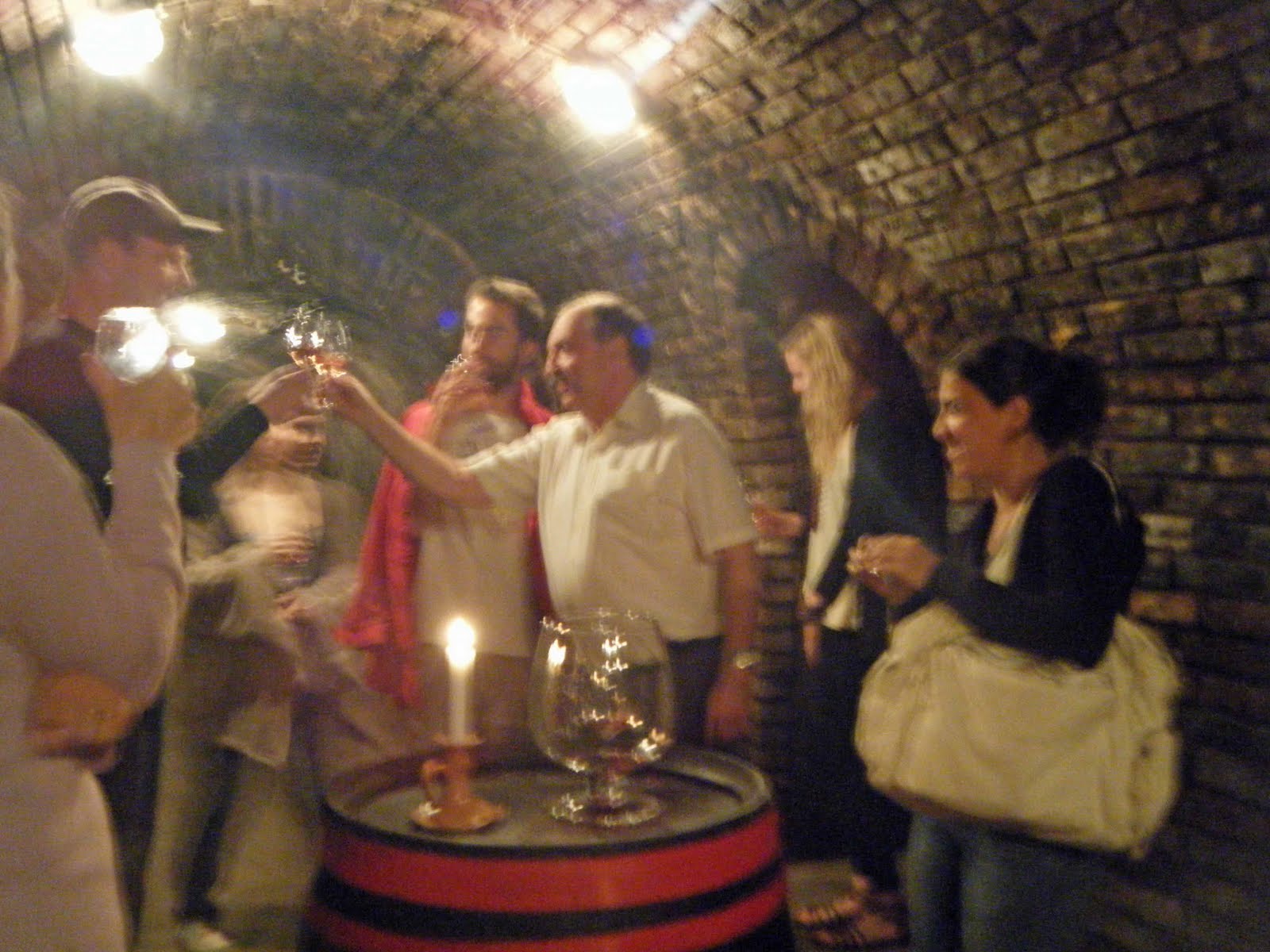

The cellars themselves provide some interesting images.


There is not doubt about it. Hungarian wine in excellent. I'll have a ver good idea of what I want to find from now on when I go wine shopping.
We came up from the cellars to a selection of cakes. We stayed for conversation until nearly midnight. It was 0:40 when I got back to my flat after a 15 minute walk from where the bus left me off. Not a good plan considering the Eger trip the next day.
Thursday, May 6, 2010
International Week
The Faculty of Health Sciences implemented their first International Week. I believe the goal for this is to create partnerships between various universities who may send students here for clinical experiences. I learned that if a student comes from another country he or she is assigned a Hungarian student to show them around as all the signage in the hospitals and clinics is in Hungarian. They are assigned to a clinical situation in which the head nurse or whatever also speaks English. They are also assigned a clinical mentor and clinical instructor from the Faculty.
Professors came from Greece, Turkey, England and Austria. I walked first to the hotel where they were staying and we a did a bit of a tour of the historical sites between the hotel and a University building where we held our meetings.


We enjoyed a dinner at what is my favorite restaurants in Pecs.
The next day we gathered again for a tour of health care facilities.


Nurses work 12 hour shifts but they are a bit staggered. The usual staffing pattern is 3 nurses coming at 6 AM to relieve 2 nurse who have been there since 6 PM. In the "afternoon" 2 more nurses come and work a 12 hour shift that overlaps somehow the two 12 hour shifts that go 6-6.
I learned a lot a great deal about the advantages of a national health system when it comes to organizing care, and the only disadvantage seems to be not enough money which appears to be exactly the same problem we have with our largely private system.
In the afternoon each of the visiting faculty gave a presentation and I learned a great deal more about the condition of nursing in each of the countries, how nursing education is done, and more about issues that relate to Global Health that will be helpful for developing a Global Health course at my own university.
I'm very, very grateful to have had this opportunity. And now in a short bit I'm off for a tour of University lbirary and then we are going to Villany for wine-tasting and dinner. It's a hard life but someone has to do it.
Well it will be a bit hard. I have to be on a train tomorrow morning at 5:23 going to Budapest! Probably the blog will be silent until sometime on Sunday when I'll tell you about Villany and Eger.
Subscribe to:
Posts (Atom)